Shibli College

Shibli National Post Graduate College, Azamgarh

The aftermath of the first war of independence in 1857 was a comprehensive, devastating and massive cycle of retribution from the British against Indians in general and Muslims in particular.  The indiscriminate retribution left a trial of destruction everywhere. Sir Syed was shaken to the core. However, unlike ordinary individuals who were left wondering what has struck them, Sir Syed decided to do something for the Muslims to help them come out of their ignorance, penury and loss of power. He started a series of activities from establishing Scientific Society to School at Ghazipur. However, the culmination of efforts was the establishment of Madrasatul Ulum at Aligarh in 1875. It immediately drew a legion of resistance from various quarters. However, at the same time Sir Syed was able to collect a group of distinguished individuals around him at Aligarh. Soon the college along with Tahzibul Akhlaq made people think about their course of action. Slowly but surely it started making a positive influence on the Muslim mindset regarding English education.

One of the earliest manifestation of this was the establishment of an English medium school at Azamgarh. The school was started by Allama Shibli Nomani. Shibli joined Aligarh in February 1883 and just after four months of service at Aligarh he laid the foundation of National School at Azamgarh City on 26 June 1883. Shibli became the secretary of School and arranged land from his family for the same. The school became middle school in 1887 and High School in 1895 (Nadvi, S.S., 1943, pp. 133-134). It became Inter College in 1940 and first degree college of the district in 1946 (Al Azmi, M.I., 2019). Post Graduate classes started in 1970 in various science and arts disciplines. In the beginning the College was affiliated to the Agra University. Later it was affiliated to Gorakhpur University. Since 1988, it is affiliated to Vir Bahadur Singh Purvanchal University, Jaunpur. The College also study centre for many courses in distant mode for various Educational Institutions of National repute. It offers various courses of Maulana Azad Foundation (New Delhi) and Uttar Pradesh Rajarshi Tandon Open University (Prayagraj). It is also a study centre for several professional and technical courses of Jamia Millia Islamia (New Delhi)

At present the College is a Muslim Minority College with five faculties and 24 departments offering a range of courses at Graduate and Post Graduate level. The College also offers Ph.D. facility in various disciplines. The college has following Faculties and Departments (http://shiblicollege.ac.in/About.aspx):

Faculty of Science – It comprises of Department of Botany, Department of Chemistry, Department of Mathematics, Department of Physics, Department of Zoology, Department of Computer Science

Faculty of Arts – It comprises of Department of English, Department of Geography, Department of Hindi, Department of Philosophy, Department of Sociology, Department of Urdu, Department of Arabic, Department of Persian, Department of Defense and Strategic Studies, Department of Sanskrit, Department of Economics, Department of History, Department of Political Science, Department of Education.

Faculty of Commerce comprising of Department of Commerce

Faculty of Law comprising of Department of Law

Faculty of Education comprising of Department of Teacher Education offering B.Ed.

At present Shibli National Post Graduate College is one of the biggest Muslim Minority Post Graduate College in India contributing to the progress and prosperity of the community and Nation and carrying forward the mission of Aligarh Movement.

Notes:

Founder: Allama Shibli Nomani

Place: Azamgarh City, Uttar Pradesh, India

Minority Status: Muslim Minority

Website: http://www.shiblicollege.ac.in

References:

Al Azmi, Mohammad Ilyas (2019) Shibli National School Azamgarh ki tareekh ka ek warq. Tahzibul Akhlaq, September, Vol. 38, No. 9, pp. 42-45.

Nadvi, Syed Sulaiman (1943) Hayat e Shibli. Darul Musanneffin Shibli Academy, Azamgarh.

Nawab Sultan Jahan Begum (9 July 1858- 12 May 1930)

(Residential halls of Aligarh Muslim University: Person behind the name series/ blog 4)

Begum Sultan Jahan Hall

Begum Sultan Jahan Hall is tribute of Aligarh Muslim University to its first female Chancellor and one of its biggest supporters since its infancy. The Hall was established on September 2008 as a hall of residence for female students of the University. At present the Hall has four hostels named Block A, Block B, Block C and Block D.

Birth and Early Education

Born on 9 July 1888 in Bhopal (Hamid, R., 2011) was the eldest and only surviving child of Nawab Begum Sultan Shah Jahan and H.H. Nawab Baqi Muhammad Khan Bahadur. Her early education was under the care of Nawab Sikandar Begum. She was taught Urdu, Arabic, Persian. Upon completion of her education, certificate was given by W.E.Frere. At a later stage English lessons were given by the political agent of Gwalior, A.W.Hutchinson (Fareed, Sadaf, 2020).

She became the ruler of Bhopal through a letter dated 28 June 1901, from Lord Curzon, the then Viceroy of India (Jahan, S., 1913). She was the last in the chain of successive four Muslim women rulers. The previous three being: Nawab Qudsiya Begum, Nawab Sikandar Begum and Nawab Shahjahan Begum. This is unique not only in the Islamic world but it is difficult to find such an example anywhere in world history.

Sultan Jahan and Girls Education

She was always concerned about promoting education. Her contributions towards education and particularly women education are exemplary. When Lord Edwin Montague, the British Secretary of State for India, met Begum Sultan Jahan in 1917, he noted in his diary that she was “frightfully keen on education, and jabbered about nothing else” (Naik, P., 2019). Her keenness towards education can be gauged by her complaint to Shibli Naumani. She said “My heart weeps over the educational condition of the nation. Our people are not getting any intelligence, rather they make different excuses” (Fareed, S., 2020).

Quite early during her reign as ruler of Bhopal, she established school for girls education named Madarsa Sultania. The school was affiliated to Allahabad School Board. Besides the prescribed syllabus, there was provision of teaching Quran along with its translation. The school not only had ambulance and first aid facility but it later started a separate section for teaching first aid to its students. A teachers training school was also started at the Madarsa Sultania.

During the same period she also upgraded two existing schools in Bhopal, namely Madarsa Bilqisia and Madarsa Victoria. English, Home Science, Arithmetic etc were added to the syllabus. In Madarsa Bilqisia, students were taught gardening also.

Sultan Jahan Begum opened school for Hindu girls as well by the name of Barjeesiya Kanya Pathshala. The school offered Hindi, Arithmetic and English as major subjects. She also fixed scholarship for the underprivileged students of ‘Jain Shwetambar Pathshala’.

Later on she was instrumental in the opening of Madarsa Islamia Hamidiya. The foundation of the school was laid on 5th February 1925. Similarly when her son Sahibzada Hamidullah Khan proposed to start a college in Bhopal for girls by the name of Sultan Jahan College, she enthusiastically supported the move.

Upliftment of Women

Sultan Jahan Begum was always interested in the upliftment of women as was always thinking of ways to do so. For the same purpose she established ‘Ladies Club’ in Bhopal. The idea was to encourage women to do something positive for the society. She organised event for the same purpose under the aegis of All India Women Association and presented her acclaimed address entitled ‘Issues of Women’. At the event she announced the establishment of Sultan Jahan Endowment Trust with a contribution of three lakh rupees to support meritorious and needy students.

Later she started ‘Girls Guide School‘ to motivate girls to engage in creative activities. She also started a nursing school by the name of ‘Lady Minto Nursing School‘.

Support to Madaris

Besides secular education, she was always ready to support religious education. She supported Madarsa Nadwatul Ulema, Lucknow, from its inception. She approved an annual grant of twelve thousand rupees for the same. Another major contribution was her support to Madarsa in Makkah.

Sultan Jahan Begum and Aligarh

Sultan Jahan always had connection with the Aligarh Movement. When Mohammadan Anglo Oriental College was established at Aligarh she immediately supported the cause. She sent her younger son Nawab Hamidullah Khan to Aligarh where he studied for six years like any ordinary student of the day.

She was always involved in the affairs of All India Educational Conference. In the conference meeting in 1910 in Allahabad she was told about the need to start a movement to upgrade the college to University by Prince Agha Khan and Nawab Waqar ul Mulk she immediately sanctioned one lakh rupees and also promised to talk to Nizam of Hyderabad to contribute to the cause.

Similarly late when convinced of the need for a building for All India Educational Conference, she sanctioned fifty thousand rupees. On 27th February 1914 the foundation of the building was laid by her at Aligarh and on 5th February 1916, the building was inaugurated. Presently the building is known as Sultan Jahan Manzil which runs a coaching also.

In 1920 she became the first Chancellor of the Aligarh Muslim University till her death in 1930. After her death her son Nawab Hamidullah Khan was appointed the Chancellor of the University. She was the first female Chancellor of any India University and so far is the only female to have held the post of Chancellor of Aligarh Muslim University in its more than hundred years of existence. She attended the first convocation of the University in 1922 where she gave speech at Stretchy Hall.

Sultan Jahan Begum and Seeratun Nabi

Begum sahiba was always ahead of others when it came to contribute for any religious cause. When she was appraised of the plan of Allama Shibli Nomani to write a book on the Seerat of the Prophet, she enthusiatically supported the idea and fixes a monthly stipend for Shibli so that he can focus on his research and be relieved from worries about household expenses. Shibli acknowledged the same by writing the following lines:

Masarif ki taraf se mut’ma’in hun main bahar surat

Ke abr faiz e Sultan Jahan Begum zar afshan hai

Rahi taaleef ki tanqeed e rawayat e hai tareekhi to

Us ke wastey mera dil hai meri jaan hai

Gharz do hath hain is kaam ke anjaam main shamil

ke jis main ek faqeer be nawa hai ek Sultan hai (Shibli Nomani)

When complete Seerat un Nabi was published after the death of Allama Shibli Nomani, she further sanctioned three thousand rupees to Dar-ul-Musannifeen (Azamgarh) for the purchase of new printing press.

Sultan Jahan Begum as an Author

Sultan Jahan Begum was a prolific writer. She wrote numerous books on various subjects. Books written by her are: Tuzk-e-Sultani, Gauhar-e-Iqbal, Khiayaat-e-Sultani, Khutbat-e-Sultani, Akhtar Iqbal, Hayat-e-Shahjahaani, Tazkirah Baaqi, Hayat-al-Zaujain, Tandrustri, Hifzan-e-Sehat, Maeeshat-e-Khandani, Sweater Bunne ka Pehla Risala, Hayat-e-Qudsi, Sabeel-ul-Jinaan, Rauzatul Riyaheen, Effatul Muslimaat, Silk Shahwaar, Maqsad Asdwaaj, Seerat-e-Mustafa, Bacchon ki Parwarish, Faraez-un-Nisa, Rehbar-e-Niswan Hissa Awwal, Islamiyaat, Hidayat Baghbani, Ekhlaq ki Pehli Kitaab, Ekhlaq ki Doosri Kitaab, Ekhlaq ki Teesri wa Chauthi Kitaab, Hayaat-e-Sikandari, Falsaf-e-Ekhlaq, Tawawwo’aat wo Awamir, Hidayaat Teemardari, Bagh-e-Ajeeb (three parts), Sayahat Sultani, Azal-ur-Rahman, Muhazzab Sindagi, Madarij-al-Qur’an, Aaina-e-Sikandari, Tehzeeb-e-Niswan, Purdah.

Honours

Nawab Sultan Jahan Begum was recipient of several honours. They are:

Abdicatioin of throne and Death

in 1926, after ruling Riyasat-e-Bhopal for 25 years she abdicated her throne in favour of her youngest child, Nawab Hamidullah Khan. Thus ended the longest rule of female nawabs that the country had seen. She left for her final abode on 12 May 1930.

Legacy

The many institutions started and supported by Nawab Sultan Jahan Begum are still benefitting the society in various fields. Her legacy lives on. May Allah raise her status. Ameen.

For references and more details, please see:

Fareed, Saadaf (2020) Nawab Sultan Jahan Begum: A quintessence of educational movements in Aligarh. Sir Syed Academy, Aligarh Muslim University: Aligarh.

Hamid, Razia (2011) Nawab Sultan Jahan Begum. Bhopal: Babul Ilm Publication

Jahan, Sultan (1913) Gauhar e Iqbal. Sultan Publishers

Naik, Priya (2019) The remarkable Begums who defied patriarchal norms to rule Bhopal for more than a century. 21 May, Scroll. Available at: https://scroll.in/magazine/917529/the-remarkable-begums-who-defied-patriarchal-norms-to-rule-bhopal-for-more-than-a-century. Accessed on 11 November 2020.

https://archive.org/stream/AnIndianDiary/An%20Indian%20Diary_djvu.txt
Prof Asghar Abbas

Renowned professor, author and critic of Urdu language passed into ages on 7 September 2022. I got to know about his death from my father’s WhatsApp message ‘asghar bhai Ka aaj Delhi Apollo aspataal main inteqal ho gaya’. Inna nillahi wa Inna ilaihi rajiun (unto Him we belong and unto Him shall we return).

Professor Asghar Abbas retired as professor of Urdu from Aligarh Muslim University. Besides his immense contribution to Urdu language he was considered authority on Sir Syed and Aligarh Movement. He was very passionate about Sir Syed and Aligarh Movement. He was Fida-e-Sir Syed in the true sense. He wrote numerous articles and books on Sir Syed and Aligarh Movement. As director of Sir Syed Academy, he published numerous books and edited versions of books by Sir Syed and documents related to Aligarh Movement. His no talk was free of Sir Syed or Aligarh Movement. In his death, we have lost a great scholar of Aligarh Movement. He retired as professor of Urdu from Aligarh Muslim University. As a teacher he was very popular among his students and was well respected by his peers.

For me he was just Asghar chacha. Whenever I was in Aligarh, a visit to his home, Gulshan Dost, in Sir Syed Nagar was a must. After the death of his wife, he confined himself to his house and reduced meeting others. Whenever I visited him he would insist on tea. One by one he would hand over biscuits to me and would cut fruits himself. He never allowed me or house maid to cut fruits. He would cut himself and would give me piece by piece and would ensure that I finish all. Despite all the protests I would be literally force fed. It was his way of showing affection. Despite his age he would make it a point to visit my home just to meet me and enquire about my daughter, Zainab. Whenever I would tell him that chacha I visited you only two days back and why you took the trouble of coming. He would always say “mohsin tumhari mohabbat kheench lati hai aur isi bahaney Zilli saheb se bhi mulaqaat ho jati hai“.

He loved collecting books. His drawing room cum library was part of his drawing room. Hundreds of books from floor to the roof neatly kept in glass shelf were a sight to behold. Whenever his book was published he would personally bring a copy to my house. He knew my father for almost five decades. Both had immense respect for each other. Whenever he met my father the discussion would always be academic. Many times he would come to my house just to discuss meaning of some Urdu words which had Arabic or Persian root from my father. When we were staying in university quarters in Zakir Bagh (C-20) it was near faculty of arts in which Urdu department is situated. At times he would pass by our house. He would ring the bell. Say salaam to my father and would leave for his classes. When we invited him inside the house his standard reply would be ‘bas Zilli saheb ko dekhney Ka Dil chah Raha tha. Dekh Liya tassalli ho Gayi ab chalta hoon. Phir Kabhi fursat se auonga’. It’s hard to find such love, such respect now a days.

He was a thorough gentleman, very soft spoken and always well dressed. Be it sherwani or suit with matching tie, he was known for good taste of cloth selection. Ashgar chacha never learnt driving and always preferred walking or using the services of rikshaw. Later he bought a car and kept a driver but would still prefer walking.

I met him at his residence during my India visit in January 2022. I had chance to meet him again in July 2022 but he was in hospital. During my hospital visit I found him quite week. May Allah rest his soul in peace and May Almighty raise his status in the hereafter.

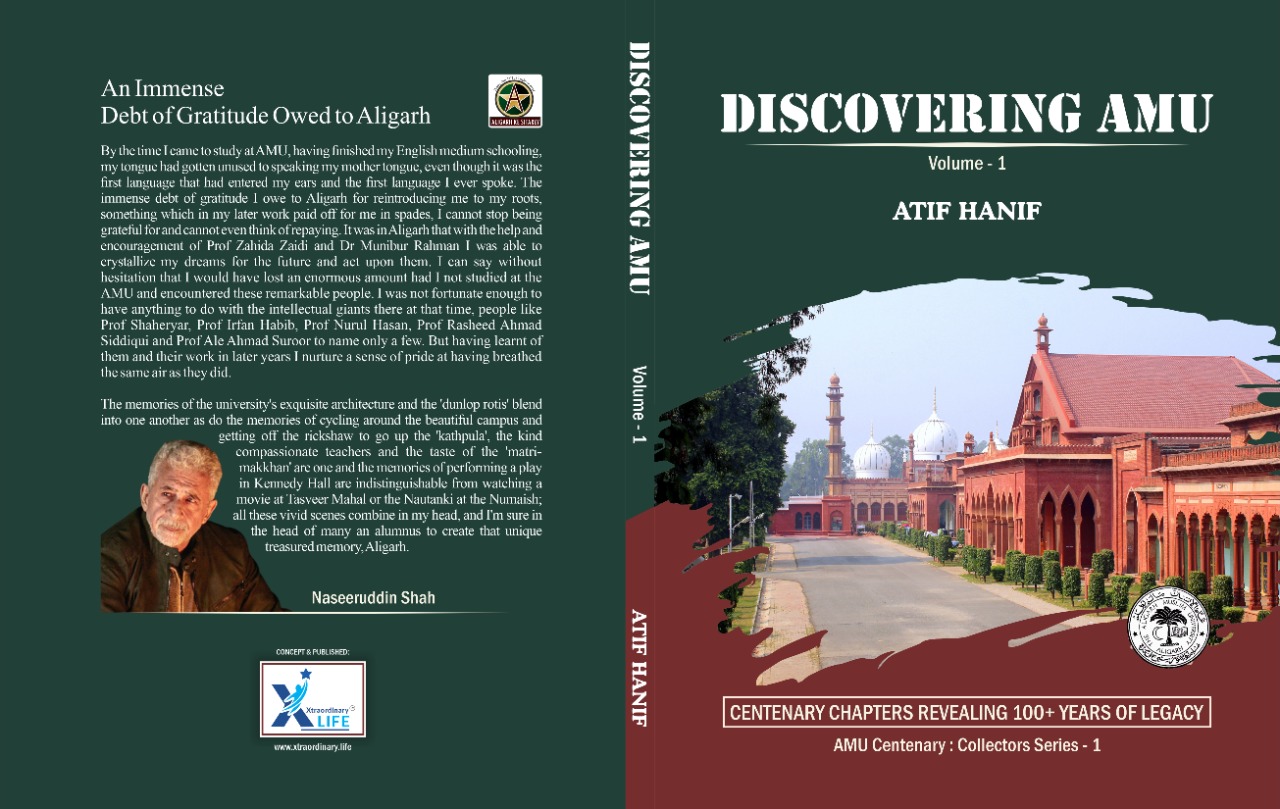
Book Introduction: Discovering AMU, Volume 1,2 (Atif Hanif)

Author: Dr. Mohsin Aziz

Recently Aligarh Muslim University celebrated Centenary of its existence. The establishment of the Aligarh Muslim University was culmination of Sir Syed Ahmad Khan’s dream. It was untiring hard work of Sir Syed and his colleagues and later his successors that the small school that Sir Syed started in 1875 at Aligarh metamorphosed into a modern University by the name of Aligarh Muslim University in the year 1920. The centenary was celebrated with lot of vigor and a plethora of activates at the University. Inauguration of the Centenary Gate at the University and the address of the Prime Minister at the Annual Sir Syed Day along with the launching of a stamp on Sir Syed by the Prime Minister were the highlights.

Alumni of the University also celebrated the occasion by various means all over the Globe. Besides other activities, a number of books and articles were also published to commemorate the occasion. One such attempt to pay tribute to the University and celebrate the occasion is a two volume book by Atif Hanif. Atif is a brand and marketing professional from Lucknow. He was my class fellow at Aligarh during MBA (1997-1999) and a very dear friend.

Front and back dust cover of Volume 1
Front and back dust cover of Volume 2

The theme of the two volume book as mentioned on the cover page is “Centenary chapters revealing 100+ years of legacy“. The idea of the book is to capture the 360 degree view of the University in the past 100 years with the help of photographs in the coffee table book mould. The book contains valuable collection of photographs submitted by Alumni from all over the world. There is calligraphy, paintings, maps, letters etc. covering varied aspects of the rich and proud history of the Aligarh Muslim University and Aligarh Movement. The book is without doubt a welcome addition to the growing literature on the University.

Details about the Book Book

Author: Atif Hanif

Weight: 2730 Grams

Hardcover: 584 Pages

Volumes: 2

Language: English

Dimensions: 29.7 cm x 21 cm

Price: 2000 INR

ISBN: 978-81-947980-4-0

Publisher: Xtraordinary Life Media Pvt. Ltd.

The book can be ordered online at: http://www.xtraordinary.life