Magical Cappadocia: Two Amazing Days in Central Anatolia

After spending two hectic days in Istanbul it was time to move to Cappadocia. It was a comfortable 1 hour 35 minutes flight from Istanbul’s Sabiha Gokcen International Airport to Keyseri Airport by Turkish Airlines. Our stay in Cappadocia was in a small city called Urgup. It is capital of Cappadocia province. Urgup is about 50 kilometers from Keyseri Airport. The drive was about 1 hour 15 minutes from Keyseri Airport to our hotel in Urgup. The landscape on the way dry and mountainous somewhat like outskirts of Muscat. There is nothing of importance between the two cities.
Urgup is town in the historical region of Cappadocia. In Turkey it is also known as the town of the Librarian with Donkey. Mustafa Guzelgoz was a librarian in Urgup. He used to travel to nearby villages with books on donkeys to lend books so as to inculcate the habit of reading in the people. Hence the name “Librarian with Donkey”. Today Urgup is a major tourist town in Cappadocia and is known for its trademark cave hotels. There are cave hotels everywhere. It’s all related to geology. Millions of years ago there were active volcanoes in this region. The lava flow of the erupting volcanoes left porous stones called Tuff everywhere. Because these stones were not very hard, people started carving homes in them. Later on when people shifted to concrete houses some of these dwellings were converted into what are today called as cave hotels. Today Cappadocia is full of cave hotels. These are fitted with every possible luxury and very comfortable as well as naturally very cool. Today Cappadocia region is known for its cave hotels, fairy chimneys, hot air ballooning, pigeon holes and ancient underground cities. Some of early Christianity’s most important landmarks are in the region thus bringing in a lot of tourists.

Urgup City Square at Night. Photo Credit & © Mohsin Aziz


Hundred Year Old Turkish Hamam at Urgup

Urgup City Bath is an Urgup Institution and Landmark. It is more than 100 years old family run Turkish Hamam near city center. Photo Credit & © Mohsin Aziz


We spent two days in Cappadocia. Our hotel in Cappadocia was Roca Cappadocia. It was a cave hotel. There was every modern facility inside the cave. The rooms were naturally cool and there was not need for Air Conditioning. The staff of the hotel was very polite. Most of the staff were female and used to call my wife as hurram (the word hurram is often prefixed with female names in Turkey as a sign of respect. It actually means ‘the cheerful one‘). Special thanks to Canan and Yasemin for taking good care of us.

Roca Cappdocia Cave Hotel, Urgup

The Courtyard of Roca Cappadocia boutique Cave Hotel. Photo Credit & © Mohsin Aziz


IMG_0215

Exterior of our room at Roca Cappdocia. Photo Credit & ©Mohsin Aziz


Our tour operators in Cappadocia were HtR- Hit the Road. They were arranged by our main tour operator in Istanbul (True Blue Tour). I found them to be extremely professional with vehicles in top condition and excellent multilingual tour guides. First day our tour guide was Kezban. She was fluent in Spanish and English. Our group besides my family included two Spanish couples and one Singapore couple. As our guide explained every detail in both Spanish and English it gave us plenty of time to appreciate the finer points and take photographs. It was very relaxed tour and not rushed at all. Our first stop for the day was Rose Valley. Rose Valley is an isolated valley near Urgup. It is known for its rock formations with different colours. I was expecting to see lots of rose thinking that the valley must have got its name from presence of rose flowers. It is not so. The name is given because of presence pink and red colour rocks in the valley. We trekked the whole valley which must be anywhere between 3 to 4 kilometers. At many places we saw farms of grapes, apple and apricot. I also saw many almond trees but our guide told us that they were wild almonds and were poisonous.
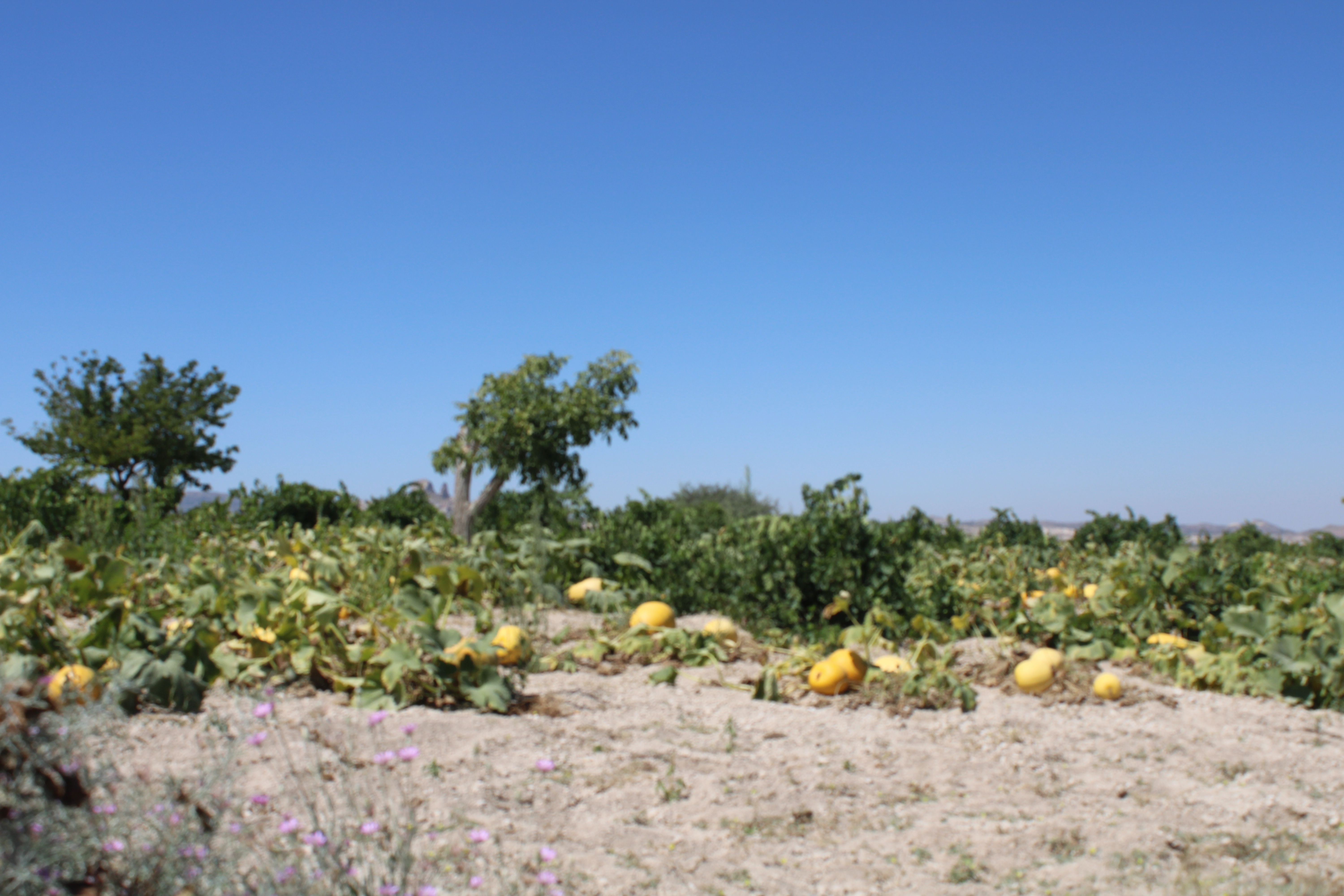
Sweet Melon along the walking track at Rose Valley

Sweet Melons along the track in Rose Valley. Photo Credit & © Mohsin Aziz


Road to nowhere at Rose Valley

The road to nowhere. Our track in Rose Valley. Photo Credit & © Mohsin Aziz


IMG_0231

A general view of Rose Valley. Hues of pink colour can be seen, hence the name. Photo Credit & © Mohsin Aziz


From Rose Valley the next stop was Devrent Valley near Cavusin Village (Pronounced as Kavushin). Unlike other valleys in this region, Devrent valley was never inhabited by humans. It is basically a group of rocks which have naturally got different animal looking shapes due to years of rain and wind. Just like shapes of clouds no two people agree what animal or shape a particular rock looks like. One can see rocks looking like double humped camel, dolphin or even a group of rocks looks like dancing dervishes. It is also called imagination valley. It’s fun for kids and even adults were acting like kids trying to identify and arguing among themselves whether a particular rock is shaped like a dolphin or something else?

Cavusin Village

A view of Cavusin village in Cappadocia. Photo Credit & © Mohsin Aziz.


Is that a Camel or Llama. Keep Imagining @ Imagination Valley

Is it a double humped Camel or a Llama. Keep Imagining @ Devrent Valley a.k.a. Imagination Valley. Photo Credit & © Mohsin Aziz.


By the time we finished from imagination valley it was time for lunch. I was a bit apprehensive as to what type of lunch are we going to get in a small village restaurant. But to my surprise the restaurant was really huge. There must have been at least 200 people already dining and still our seats were reserved. The variety of food was amazing. Of all the places I never expected to see Shahi Tukda as one of the sweet dishes. I must have eaten at least four or five pieces of Shahi Tukda. I think after 4 kilometers of walk I deserved this.

Our next stop for the day was historical underground city of Kaymakli. Kaymakli is a UNESCO World Heritage Site. There are many underground cities in this region. Some have better defense system, some have more floors but Kaymakli is the largest one. Cappadocia lies on the silk route and other historically important trade routes hence various kings have tried to capture it. The present day Cappadocia has been at the center of some of the greatest civilizations and military power and their jostling for power. These cities are supposed to be built around 3000 B.C. during Hittites and Phrygians.  The inhabitants of this place built whole cities under their houses and would go underground to escape the marauding armies whenever their was attack.  Later on Assyrians, Akkadians, Romans, Seljuk’s,  Iranians and Byzantines vied for power in the region until the Ottomans established their rule in the region. Early Christians during the 4th century used these cities to escape religious torture. It is estimated that around 3500 people once lived in Kaymakli. There is a maze nearly one hundred tunnels in the Kaymakli underground city. It has eight floors of which four are open to the tourists.  The underground spaces are arranged around ventilation shafts so as to supply fresh air. Each floor used to serve a particular purpose. The first level was used as stable for animals. Another level was used as grain storage, winery and oil presser. One floor was used as living place. Another one has churches, chappels, graves, communal kitchen etc. We went up to four floors which are allowed for tourists. The path downwards is very steep. Although some people in our group came out from the first floor itself feeling claustrophobic. I went to the fourth floor underground and found it surprisingly well ventilated. Today these underground cities of Cappadocia are a must do for tourists to this region. 

Inside Kaymaki underground city

One of the underground tunnel at Kaymakli Underground City, Cappadocia. Photo Credit & © Mohsin Aziz.


20190810_143853

Big Round Stone carved in Second Floor Underground. It was used as defense mechanism to close the tunnel in case of attack from outside. Photo Credit & © Mohsin Aziz


Second day in Cappadocia was Eid Al Adha. I had already found a mosque named Merkez Mustafa Aga Camii near to hotel and prayed Isha (last of the obligatory five prayers. Prayed around 1 and a half hours after sunset) so as to get an idea of the place. The Eid prayer was at 6.15 a.m. I reached the Mosque at 6.10 with a prayer mat which i had brought from Muscat anticipating huge rush at the Mosque. However i was surprised to find attendance at the Mosque to be thin and i found myself in the fourth row. I counted 68 people including myself and the Imam. There were very few youngster. Most of the people who gathered for Eid Prayer were elderly. The imam was dressed in trouser and shirt with tie thrown in for good measure. The first Khutba (Sermon) was in Turkish while the second was in Arabic. The prayer was short. It was a unique experience for me. Just opposite the Mosque is a Urgup Landmark. Its Urgup Baths which is a traditional family run Turkish Hamam. 

Merkez Mustafa Aga Camii Mosque, Urgup

Merkez Mustafa Aga Camii Mosque where I prayed Eid Al Adha on 11 August, 2019. Photo Credit & © Mohsin Aziz.


In fact second was supposed to begin very early as we booked hot air balloon ride for that day expecting the Eid to one the previous day. However, when the Eid was not on first day, i got my ride cancelled as hot air balloons fly only early morning. Next day we found out that anyway all the balloon rides that day were cancelled due to unfavorable wind conditions. 

Our guide for second day in Cappadocia was Mr. Murat. He was also multilingual and besides Turkish was fluent in English and Spanish. Group members were same as previous day.  

Our first stop on second day was Goreme Open Air Museum (pronounced as Goreymey). It is outside Goreme city. The region is known for fairy chimneys. Fairy chimneys are naturally carved out rock formations. They change colour at the sunset. As I have mentioned somewhere, this was active volcanic region. The lava and ash which erupted millions of years ago blanketed the whole region in thick ash. With passage of time this ash solidified as soft rock and is called Tuff. With the natural elements like rain and wind striking them for millions of years, the softer parts were eroded away and only the harder parts remained. This process resulted in extraordinary rock shapes which go up to more than 130 feet high and are called fairy chimneys. When early Christians were persecuted by Romans, they fled to this region and realised that living quarters can be carved out of the soft rocks. They assembled in Goreme and carved not only living quarters high up in the rocks for themselves but also carved out innumerable churches. Goreme is perhaps the biggest collection of such churches at one place in Cappadocia. Christian monks built a maze of interconnected living quarters, stables, grain storage facilities besides churches. They also built individual prayer chambers high up in the rocks with steps carved out of the rock itself. Today Goreme Open Air Museum is a huge open air enclosure which is a UNESCO World Heritage Site. It is visited by tourists from all over the world. It is particular high up in the order of Turkey’s religious tourism ladder and is almost a must see attraction for tourists on Christianity trial in Turkey. 

The churches in the Goreme Open Air Museum are also known for well preserved Fresco Art which has survived the test of time. One of the most important churches with Red couloured Fresco paintings is the Dark Church. 

Some of the older cave dwellings have also been converted into luxury boutique hotels thus providing opportunity to tourists to partly experience the life inside rocks. 
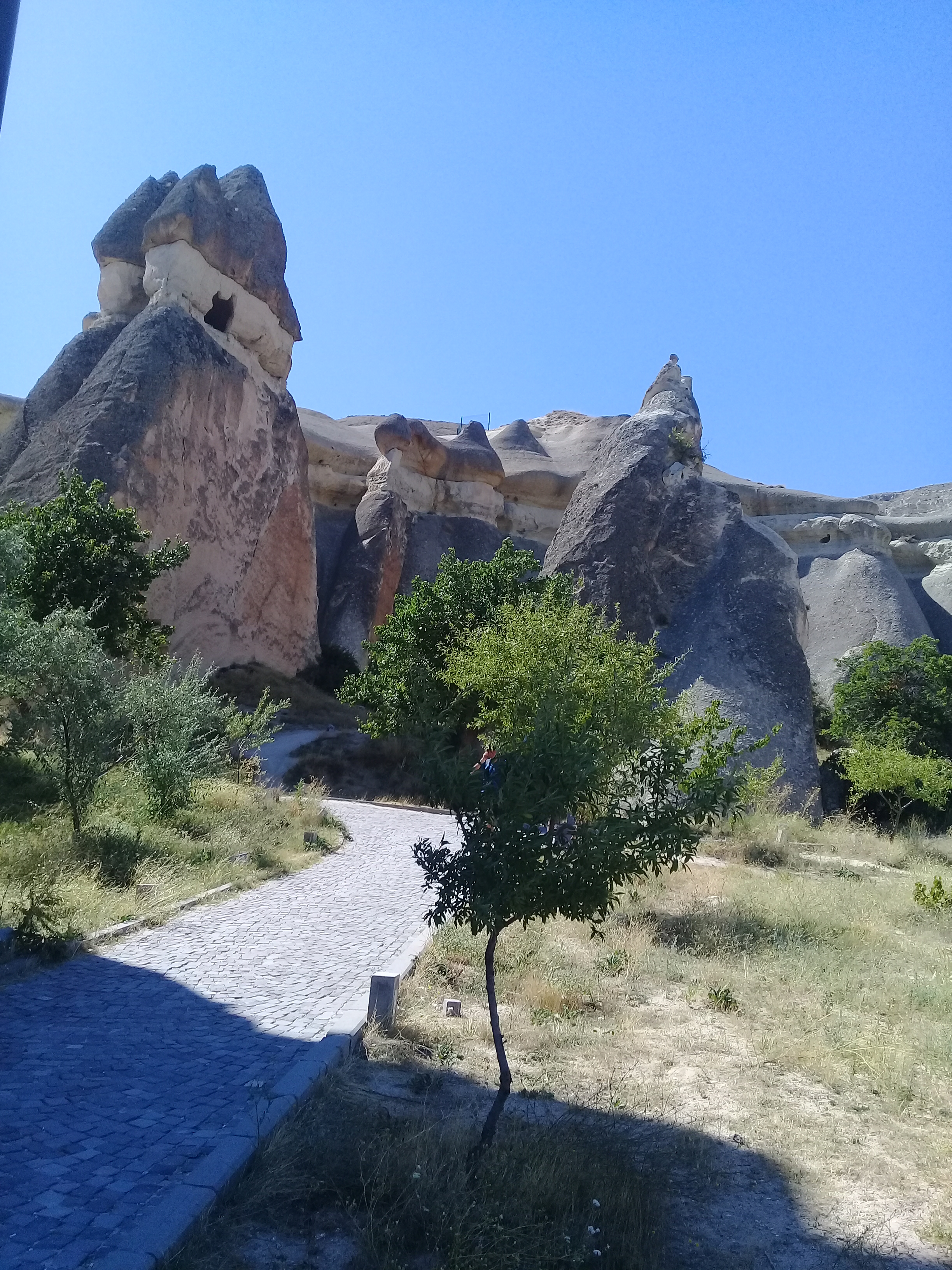
The Road Inside Goreme Open Air Museum. Photo Credit & © Mohsin Aziz
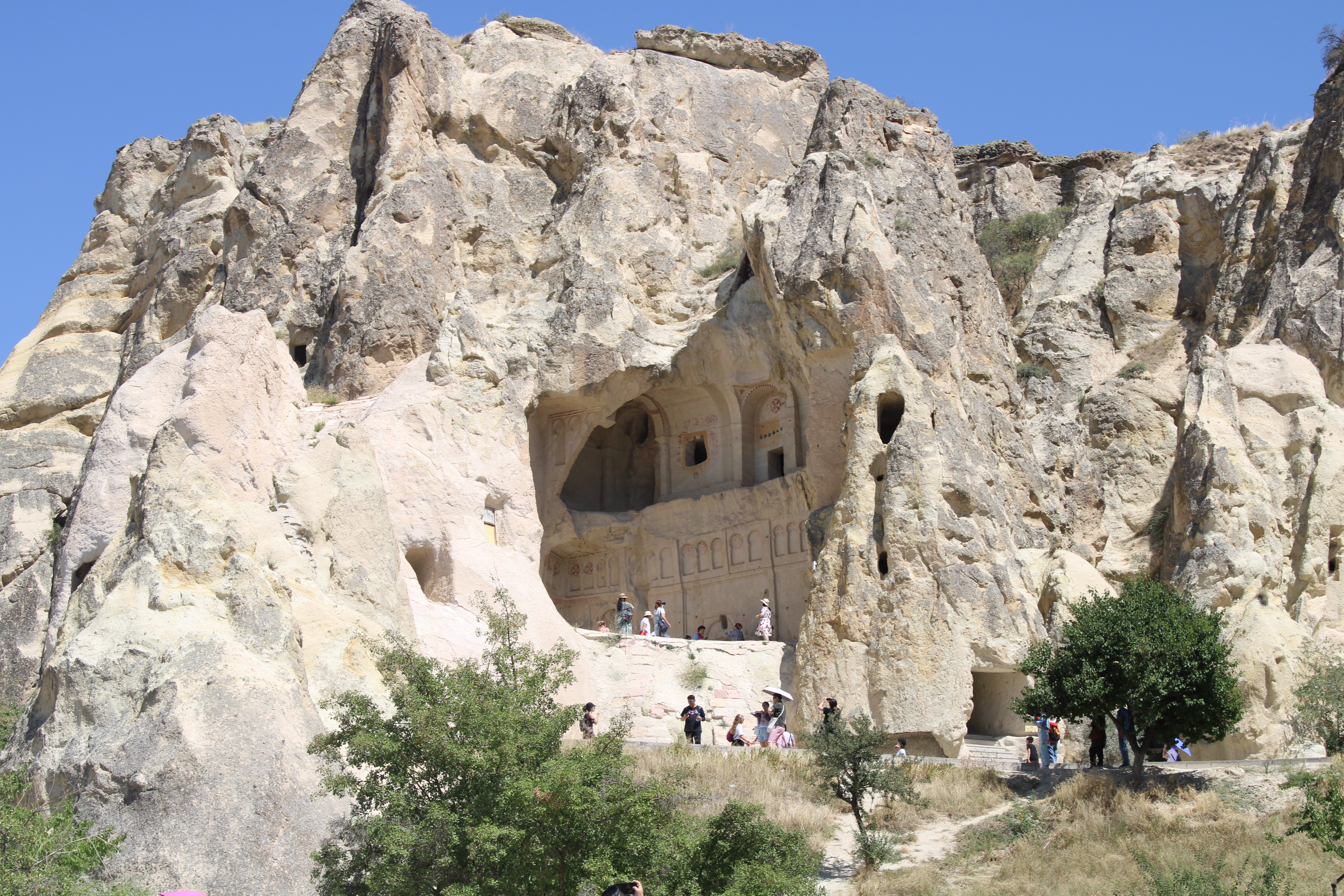
 

Dark Church cut inside the mountain at Goreme Open Air Museum. Photo Credit & © Mohsin Aziz


close up

Fresco Paintings can be seen in this close up picture of the outside part of the Dark Church at Goreme Open Air Museum. Photo Credit & © Mohsin Aziz
 

IMG_0315

Residences of Monks at Goreme Open Air Museum. Photo Credit& ©  Mohsin Aziz.


We spent around two and half an hours at Goreme Open Air Museum. It was time to move to our next destination. Before leaving the complex we went to Museum Shop at the exit and had some snacks and tea at the Museum Shop Restaurant. Our next destination was a Small Village called Avanos in Cappadocia. Its an old village which was called Venessa in old times. It is along river Kizilirmak which is also called Red River. Red River is the longest river of Turkey. It is popularly called Red River because it carries red silt with it and deposits on its banks. Avanos is also known as pottery town of Turkey. The red silt deposited by Kizilirmak river has been used since the times of Hittites to make pottery by the people of the town. The red silt in river side mud gives a unique texture to the ceramics produced here. Today the village is dominated by numerous pottery making factories. Pottery is made using traditional method. Ceramics produced here are not only sold all over Turkey but are exported all over the world. To make the visit more interesting we were given a live demonstration of pottery making at a local factory. We were shown the different stages of pottery making up to the last step of hand painting of ceramics. We saw workers hand painting various designs on ceramics before they were put on display or were packed to be transported all over Turkey. For bigger pottery and ceramic items, most of the workshops have courier facility to all over the world.  

Kizilirmak (Red River) passing through Avanos Village

River Kizilirmak (Red River) flowing through the village of Avanos. Photo Credit & © Mohsin Aziz.
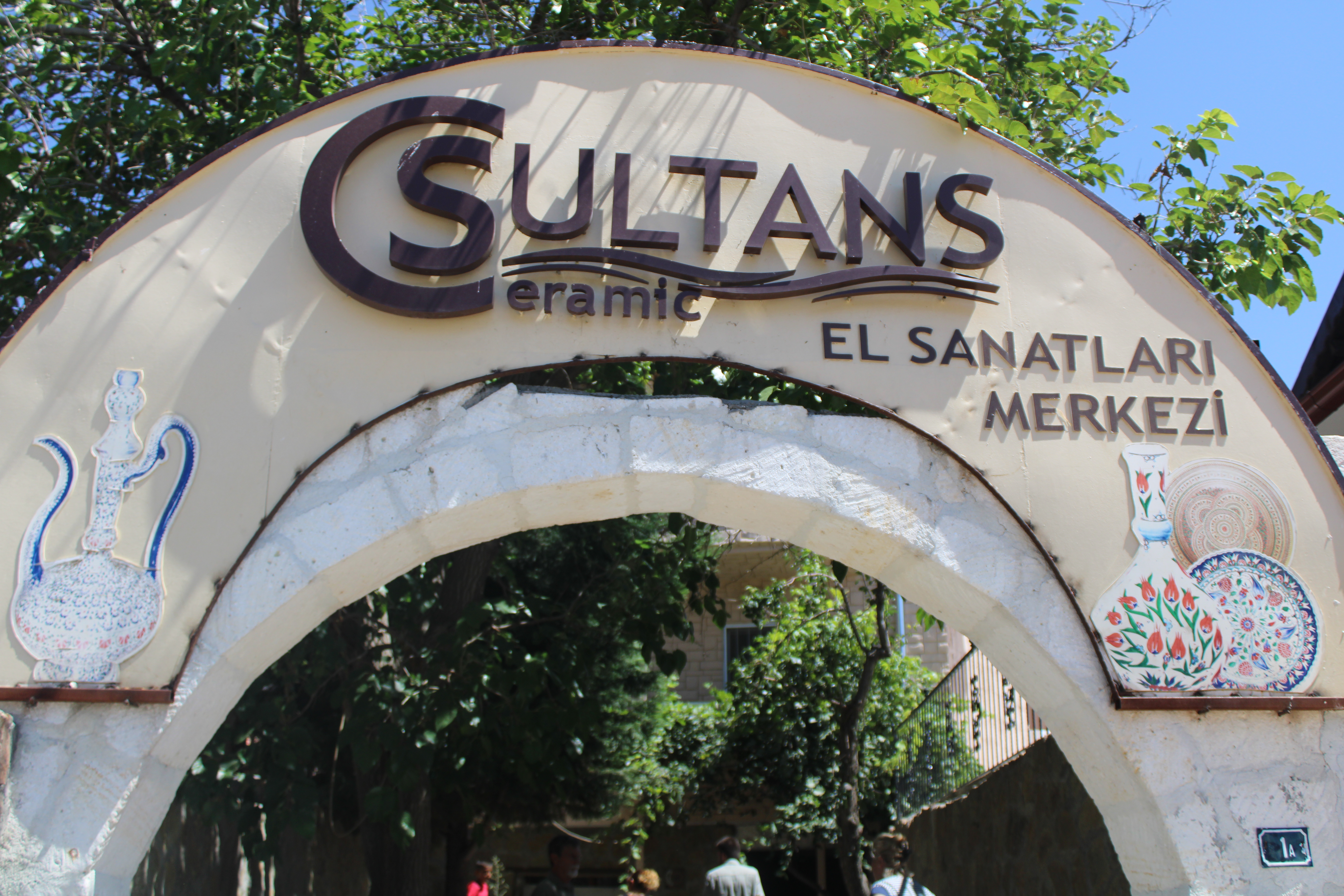
 

Entrance of Sultan Ceramic at Pottey Village of Avanos

Sultans Ceramic where we saw a pottery making session and bought some ceramics as souvenir’s. Photo Credit & © Mohsin Aziz


Ceramics inside Sultan Ceramics

Ceramics on display at Sultans Ceramics, Avanos. Photo Credit & © Mohsin Aziz.


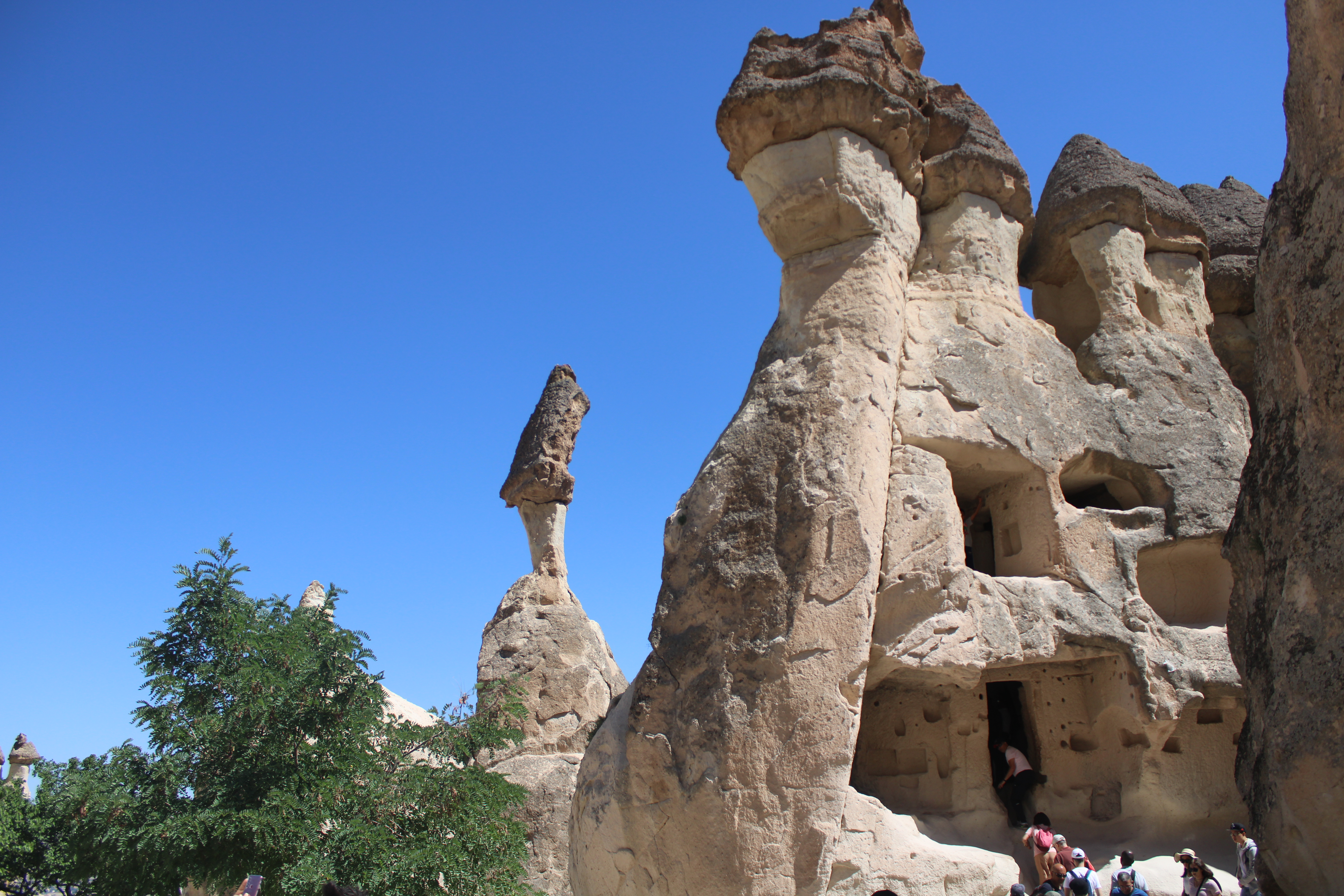
After enjoying our visit to the ceramic workshop it was time for lunch. We were taken to a restaurant next to river river. I don’t remember the name of the restaurant but it was food at the restaurant was the best Turkish food that we had in our entire stay in Turkey. It was a small but very modern restaurant. After lunch was our drive back to our hotel in Urgup. Tonight was our flight back to Istanbul. On the way back to hotel we passed through Pasabag monks valley and also saw the pigeon valley. Pasabag valley contains some of the most striking examples of fairly chimneys some of them having two or some cases even three caps. Since they look like mushrooms they are also called mushroom chimneys.


IMG-20190810-WA0004

An Aerial view of the Pasabag Valley. Photo Credit & ©  Mohsin Aziz.


20190810_123501

Monks chamber up in the rock can be seen in Pasabag Monks Valley. Steps cut in rock can be seen leading up to the chamber. Photo Credit & ©  Mohsin Aziz.


IMG_0251

Moonscape can be seen on the way back to hotel in Urgup from Avanos Village. Photo Credit & ©  Mohsin Aziz.


IMG_0311

Fairy Chimney with chamber for Monks Meditation in Pasabag Monks Valley.  This  Fairy Chimney has three caps at the top. Photo Credit & © Mohsin Aziz.


The hermits of Cappadocia in ancient times used to lead reclusive life. In order to be away from the masses so that they can meditate and contemplate they used to live in these chambers which they carved 10 to 15 meters up in the Tuffs. They used to get down for food and would go back in their chambers. On the way we also passed through what is called as Guvercinlik Vadisipigeon valley (pigeon valley). It has got its name from the innumerable dovecotes that have been carved at height in the fairy chimneys. Although such dovecotes are found in the whole of Cappadocia, they are nowhere as numerous as pigeon valley, hence the name.  In old times, these dovecots were carved to attract pigeons to sit in them. Over period of time their droppings got collected and were taken down by the farmers to fertilize their barren lands. Though pigeons don’t play important role in modern agriculture now, still many dovecotes have been maintained by the people in the Cappadocia region.

On the way back we also passed by Uchisar Castle and saw it only from outside. Uchisar Castle was used as a defense mechanism in the past against invasion. As it is the highest point in Cappadocia, the Castle provided vantage point to keep an eye on the whole region. In the past it was on the busy and vital silk route. At present Uchisar Castle is a UNESCO World Heritage Site. However, nobody in our group had energy to climb up to see the place. Everybody just took pictures from below and we moved on to a small bazaar (market) with some restaurants and lots of souvenir shops. Most of the shops were selling either different varieties of scarf or Nazar (evil eye) amulets. Evil eye beads or Nazar Boncuk is a glass bead usually of blue colour and filled with a blue or black dot superimposed on a white center in the form of a tear drop. Nazar Boncuk are quite popular in Turkey. When I inquired about them from Murat he categorically stated that it has nothing to do with Islam and is only a cultural thing. Still i was surprised to see so many Evil Eye Beads being sold everywhere in Turkey.  


Dove Cots at Pigeon Valley

Dove Cots can be seen in this Fairy Chimney at the Pigeon Valley. Photo Credit & ©  Mohsin Aziz
 

Uchisar Castle atop a rock on the way to Hotel. Photo Credit & ©  Mohsin Aziz.

Sovenier shop selling evil eye

Souvenir Shop selling Nazar Boncuk (Evil Eye Bead) near Uchisar. Photo Credit &  & © Mohsin Aziz

By the time we reached hotel it was time for dinner. We decided to take dinner at Urgup market. We found a nice hotel named Urgup Restaurant near city square. It was usual Turkish fare and i ordered a few items. However, the old owner of the restaurant came to us and insisted that we try Adana Kebapi. Also called Kiyma Kebabi, it is made from hand minced meat of only male lamb. Mincemeat is hand mixed with lamb tail fat and charcoal grilled on iron skewers. It is served with coal charred peppers and tomato. It’s named after fifth biggest Turkish city of Adana. On his insistence, Adana Kebapi was ordered and boy did i regret ordering it? Not at all. it was worth every lira spent on it. It was the best Kebap in my entire Turkey Tour. What a nice way to end our day and tour of Cappadocia. We returned to hotel as tonight we had to fly to the coastal city of Kusadasi in Izmir province. Thus ended our two absolutely wonderful days in Magical Cappadocia. 
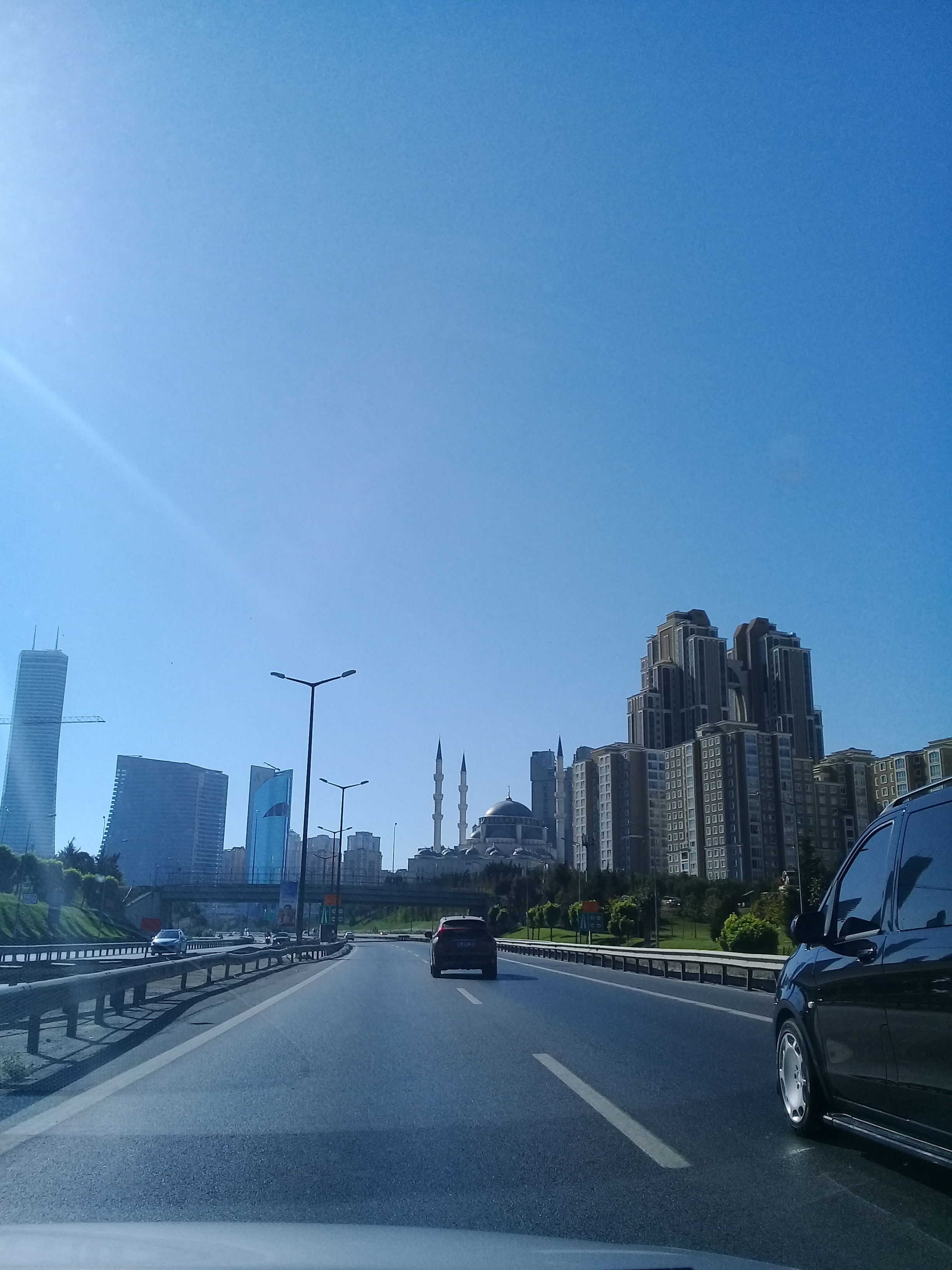


A day trip to Bursa from Istanbul

When I started planning my Turkey visit and started searching for information and reading reviews and blogs about must do places in Turkey, I read about Bursa for the first time. As I gathered more information, I decided that it’s going to be on my itinerary. It was a decision well made as I thoroughly enjoyed my visit to Bursa.
It was capital of Ottoman Empire before the capture of Constantinople in 1453. Bursa is the fourth most populous Turkish city lying on the foothills of Mount Uludag in the Marmara region of Turkey. It is about 150 kilometers from Istanbul. It’s a city well known for its mosques and buildings from early Ottoman Empire and hence holds a special place in Turkish history. It is also called Yesil Bursa i.e. Green Bursa due to presence of lots of trees in the city and the magnificent background of Mount Uludag which is covered with lush green trees. Bursa was first major Ottoman Capital and hence the presence of Ottoman buildings and mosques from that era. During Ottoman times, the city was called Hudavendigar or “god’s gift”.

There are various methods of reaching Bursa from Istanbul. However, I preferred a private tour which was arranged by my tour agency. Although a bit costly it allowed me complete control over the day’s itinerary. It also allowed us to explore whatever we wanted at leisure. It was our luck that the driver was not well and the tour agency gave us a trained tour guide, Mr. Yilmaz Ozluk, as a driver which really made the day tour to Bursa much more interesting. Yilmaz was right on time. We left our hotel at 8 a.m. It took almost 1 hour from Hotel to Pendik (Asian Side of Istanbul). Our hotel was in the European Side of Istanbul as all the important Istanbul landmarks are there.

Istanbul Asian Side

Asian Side of Istanbul. Photo Credit & © Mohsin Aziz

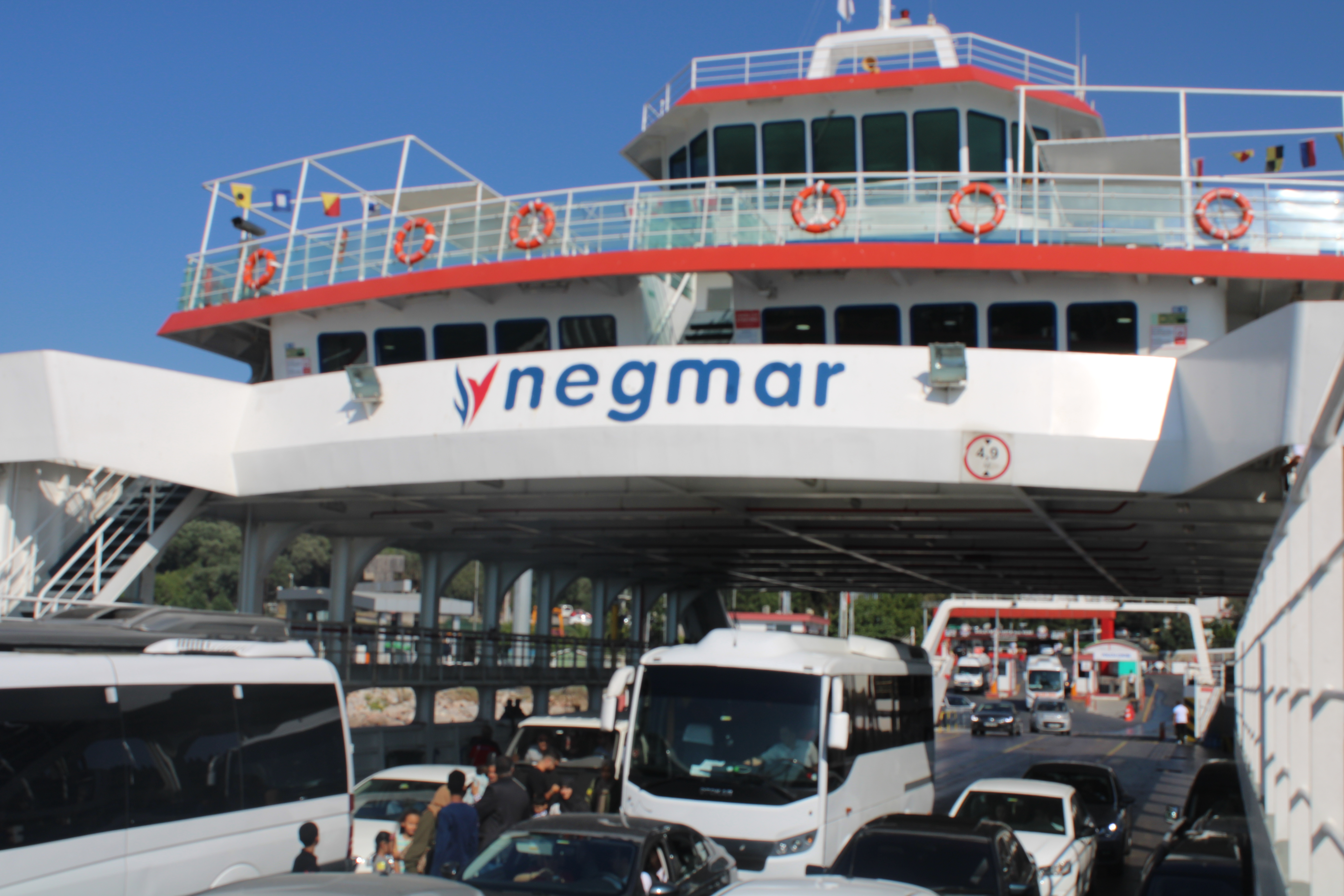
From Pendik we took a Ferry to cross Marmara Sea to reach Yalova. Ferry from Pendik to Yalova took around 45 minutes.

[caption id="attachment_166" align="alignnone" width="6000"]Parking Car in the Ferry Our Ferry from Pendik to Yalova. Photo Credit & © Mohsin Aziz
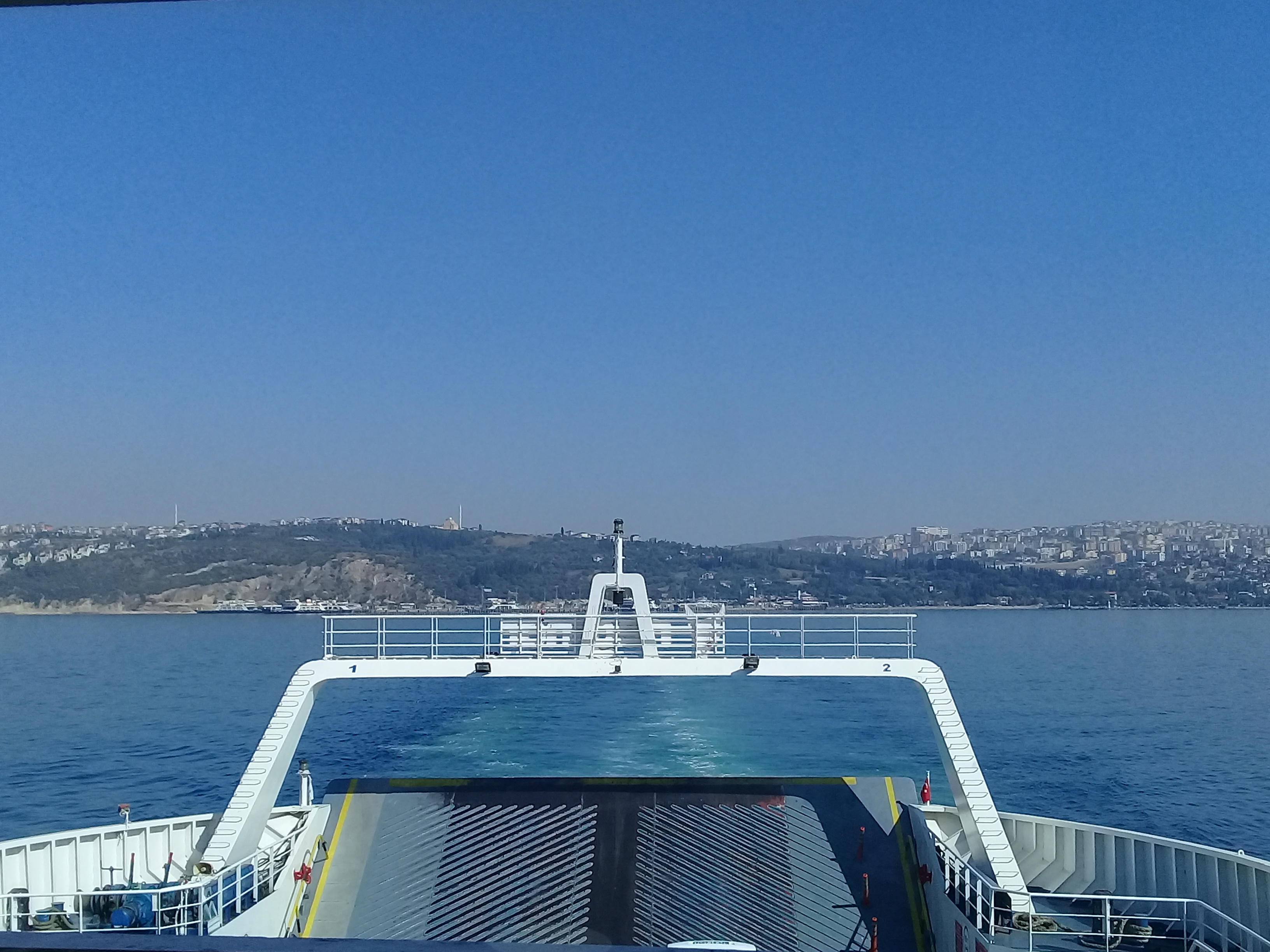
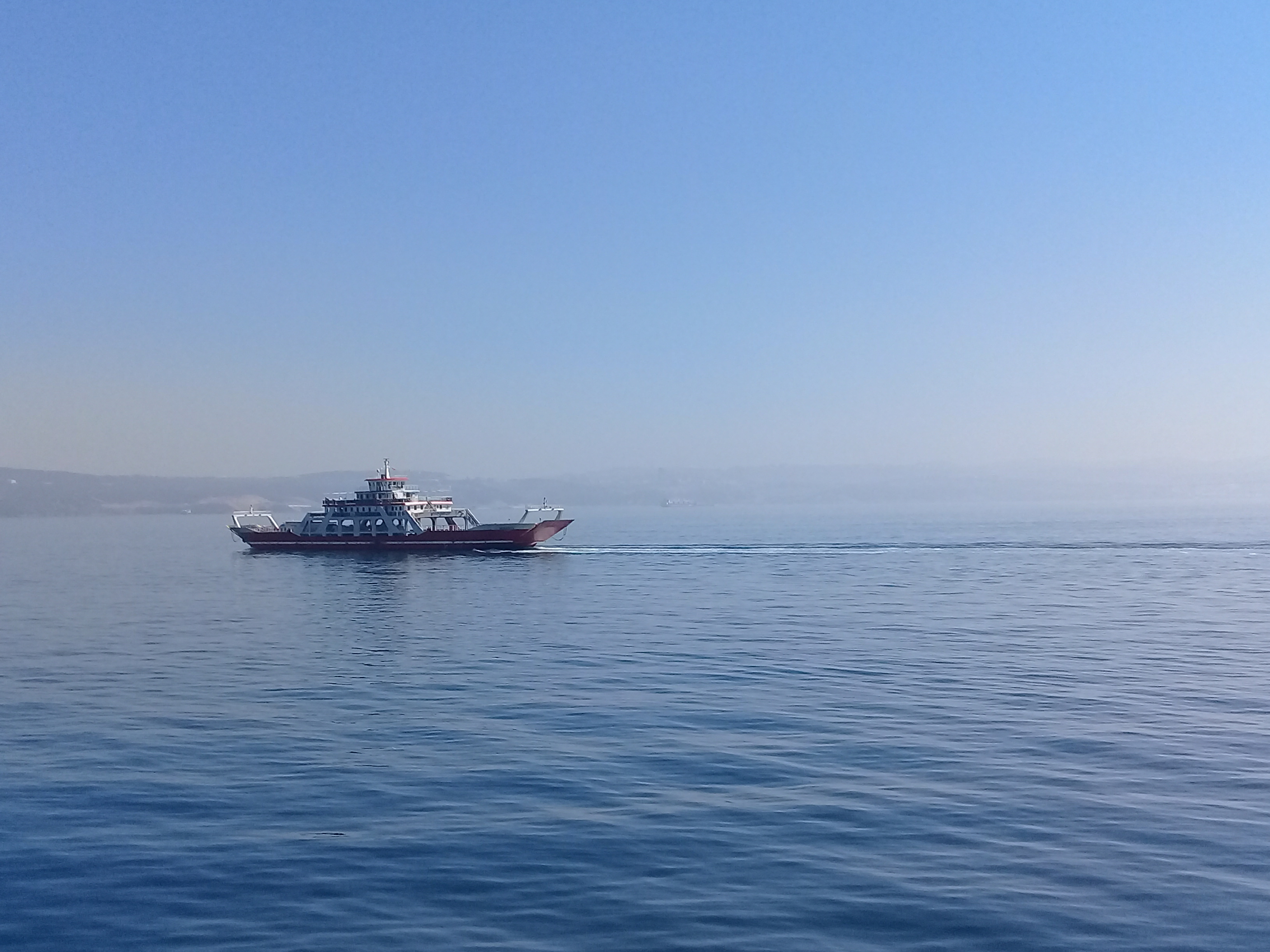
 

Ferry from Istanbaul to Yalova

Yalova city from Ferry. Photo Credit & © Mohsin Aziz


Marmara Sea

View of Marmara Sea from the Ferry. Photo Credit & © Mohsin Aziz

 Once in Yalova, it took another 10 minutes to take the car out of ferry. In Yalova, we stopped at a famous shop called Safranbolu Lokumcusu. It was a nice break and we bought some Turkish Delight, had some Turkish Apple Tea and moved on.

A View of Yalova City

A view of Yalova City outside the Port. Photo Credit & © Mohsin Aziz


Turkish Delight inside Safranbolu Lokumcusu

Stacks of Turkish Delight inside Safranbolu Lokumcusu, Yalova. Photo Credit & © Mohsin Aziz

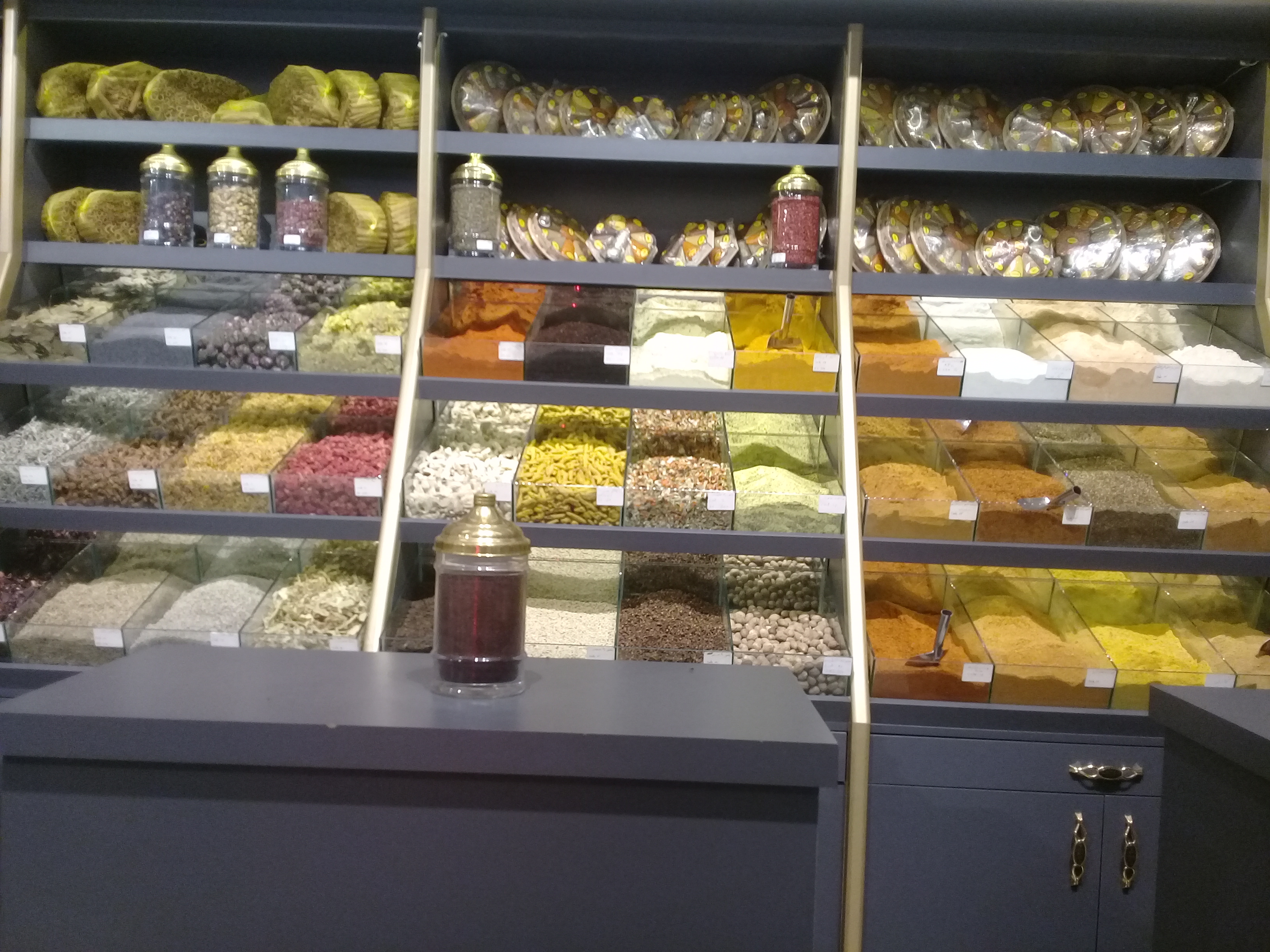
Spice Counter at Safranbolu Lokumcusu

Spice Corner at Safranbolu Lokumcusu, Yalova. Photo Credit & © Mohsin Aziz
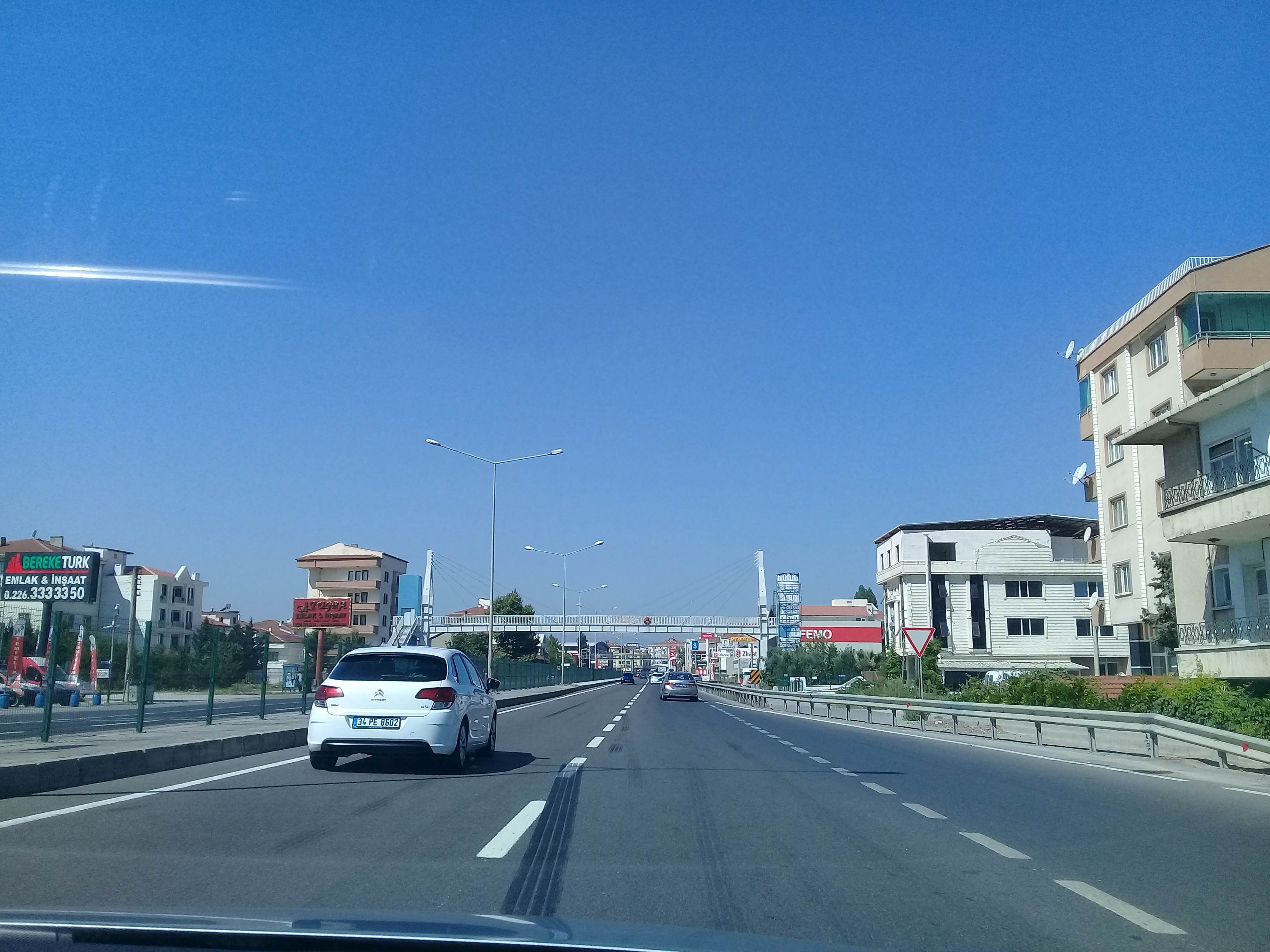
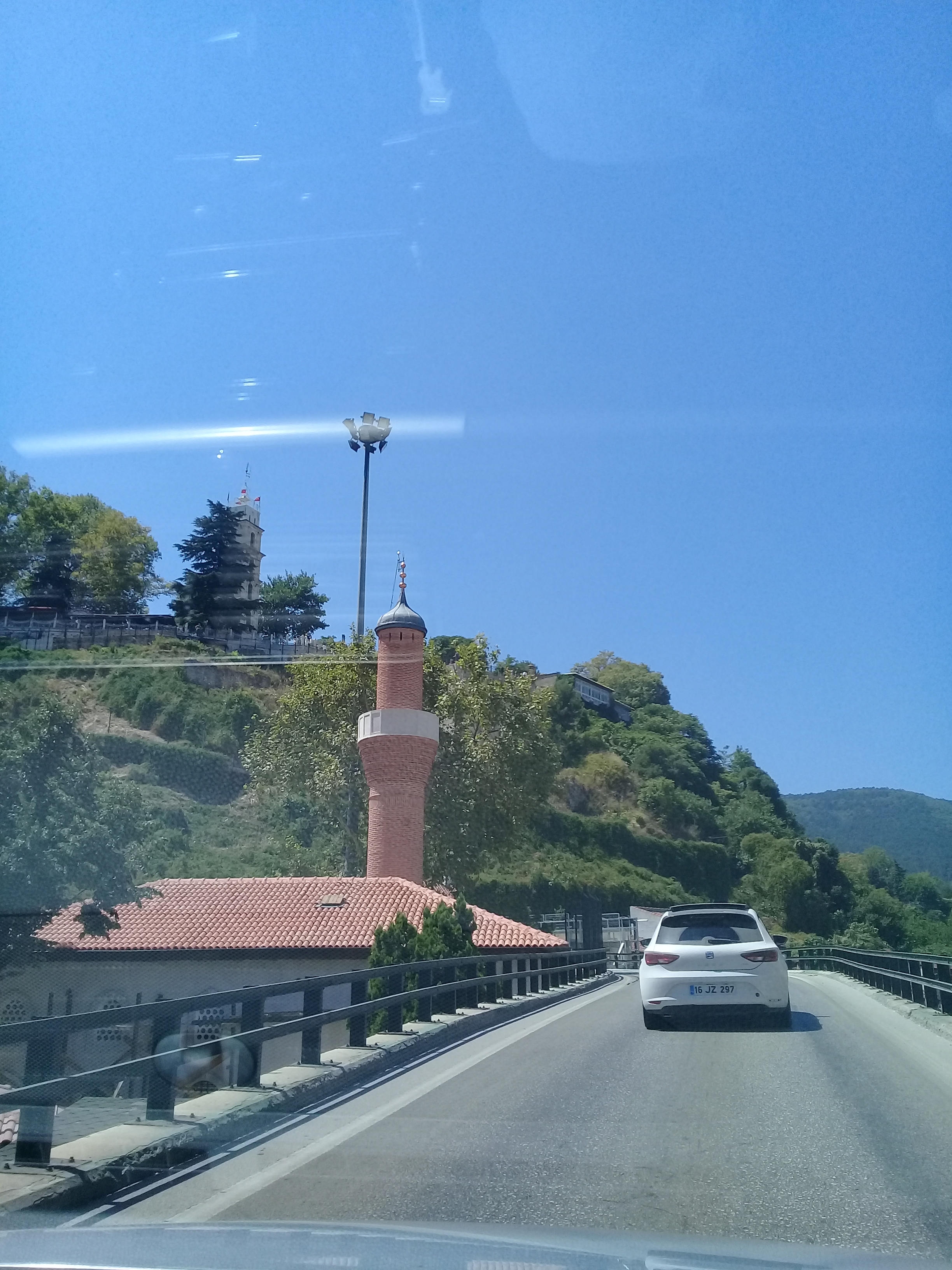
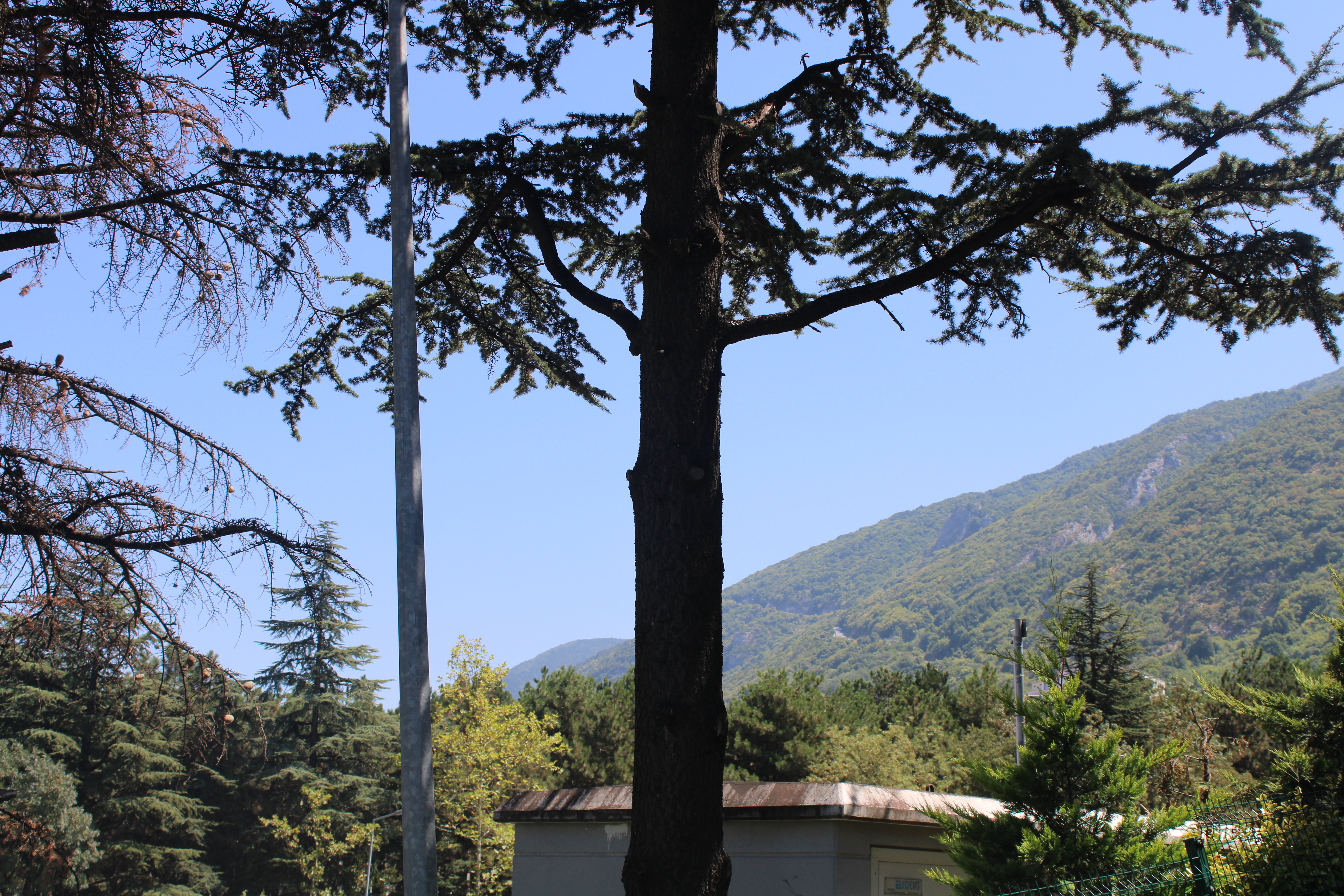
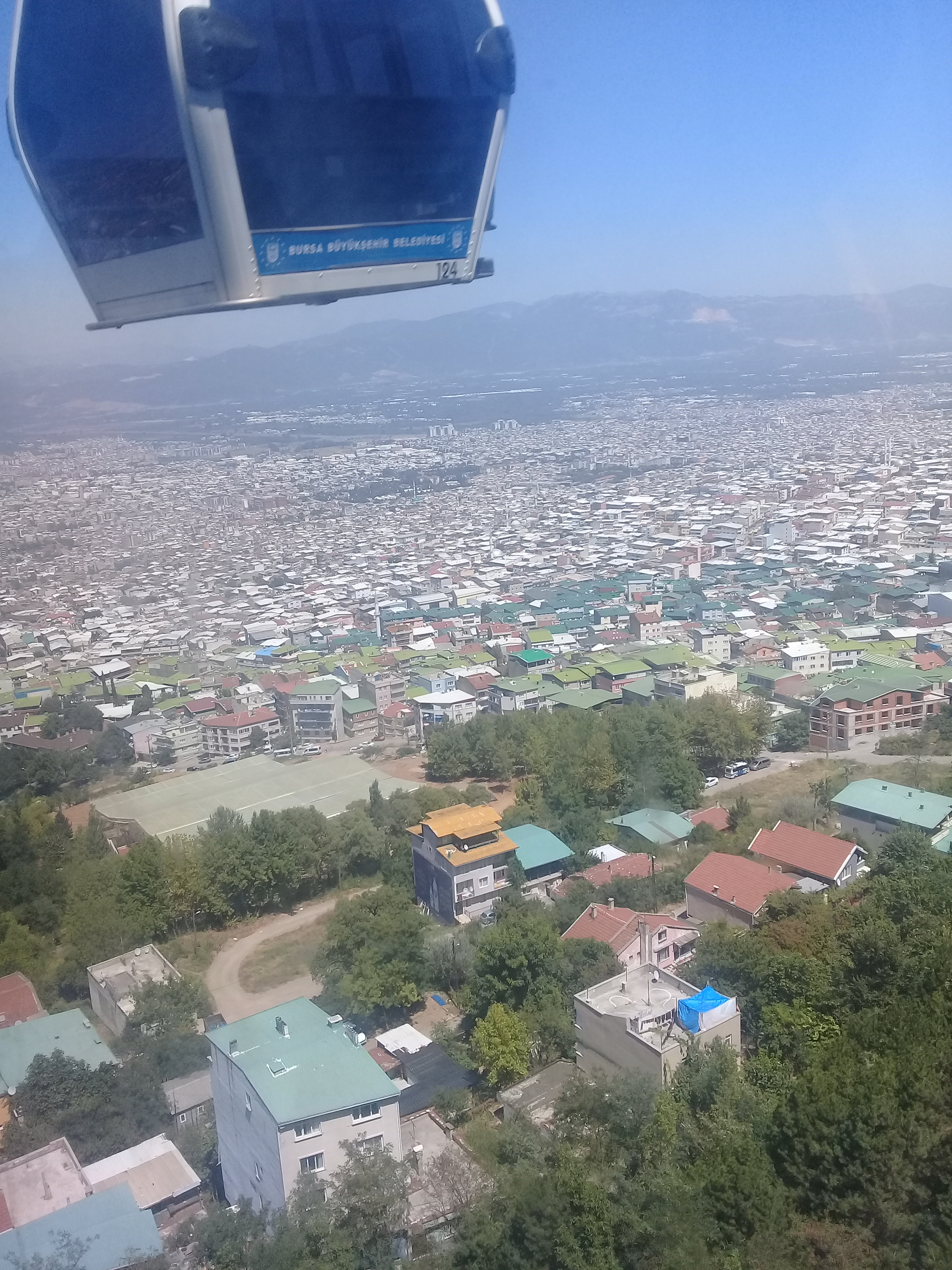
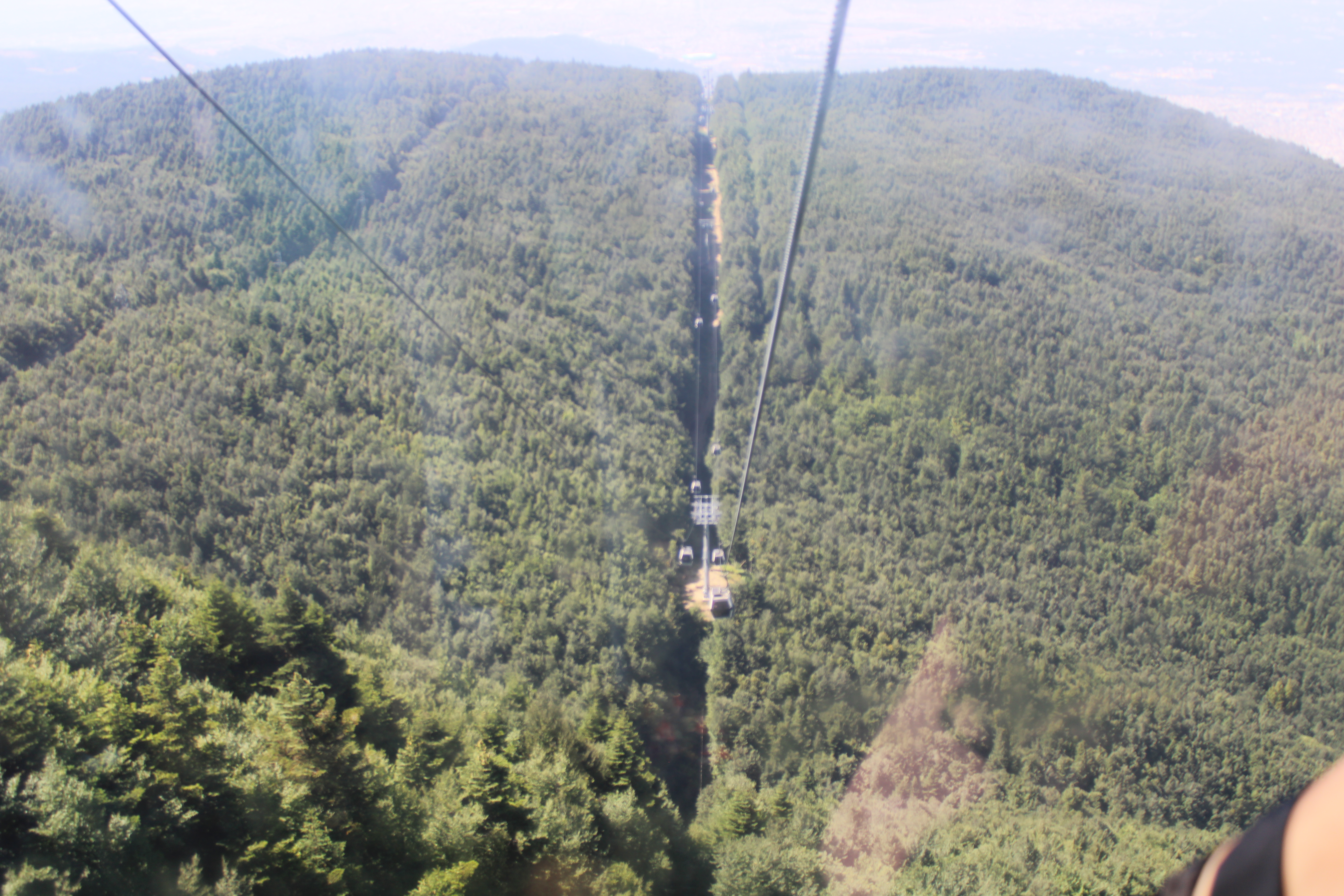
 From Yalova it was another one hour drive to Mount Uludag in Bursa. Mount Uludag means Great Mountain. It is covered with lush green trees and has sky resort at the top. People come here for winter sport such as skiing. There is a national part also in Mount Uludag. The top of the Uludag can be reached both by car as well as Cable Car which is called Teleferik. There are two stations of the Teleferik. We decided to go to the second station with a small break at the first station. It starts at Yildirim in Bursa and goes upto Oteller as end station. Sky resort and hotels are present at Oteller. The ticket cost was 93 Turkish Lira per person for up to second station. The queue for both the ticket as well as for the cable car were quite long but because we were with a certified guide (Mr. Yilmaz), we were able to jump both the queues thus saving precious time. The total length of the cable car is 8.8 km which makes it the longest in Turkey and among the longest in the World. It was a different experience as compared to Cable Cars at Gulmarg (India) and Langkawi (Malaysia). Each has its own challenge and joy. The view of Bursa city from the Teleferik was fantastic and we could see people having picnic at higher reaches of the mountain with their families.

On the way to Mount Uludag

Bursa City. On the way to Mount Uludag Teleferik. Photo Credit & © Mohsin Aziz


Ground Station of Teleferik

An Outside View from Teleferik Ground Station. Photo Credit & © Mohsin Aziz

View of Mount Uludag from Teleferik

A view of Mount Uludag from Teleferik. Photo Credit & © Mohsin Aziz

View of Bursa City from Teleferik

Aerial View of Bursa City from the Teleferik. Photo Credit & © Mohsin Aziz

Long shot of Teleferik

From First Station to Top Station of Teleferik. Photo Credit & © Mohsin Aziz

A short video of Teleferik ride can be seen here:https://www.youtube.com/watch?v=oQfsW558u2o

 
After enjoying our Teleferik ride we straight away went to Yesil Camii or Green Mosque. It is also known as the Mosque of Mehmed I. The name Green comes from the green tiles which are part of interior decoration. The Mosque is actually part of a large kulliye (complex) which consists of turbe (mausoleum), Madrasah, Bath and Kitchen. It was commissioned by Sultan Mehmed I and his turbe is part of the complex just opposite the Mosque. Yesil Camii is a fine example of early Ottoman architecture. Today it is one of the most important tourist destination not only in Bursa but in the whole of Turkey. It is also UNESCO World Heritage Site.
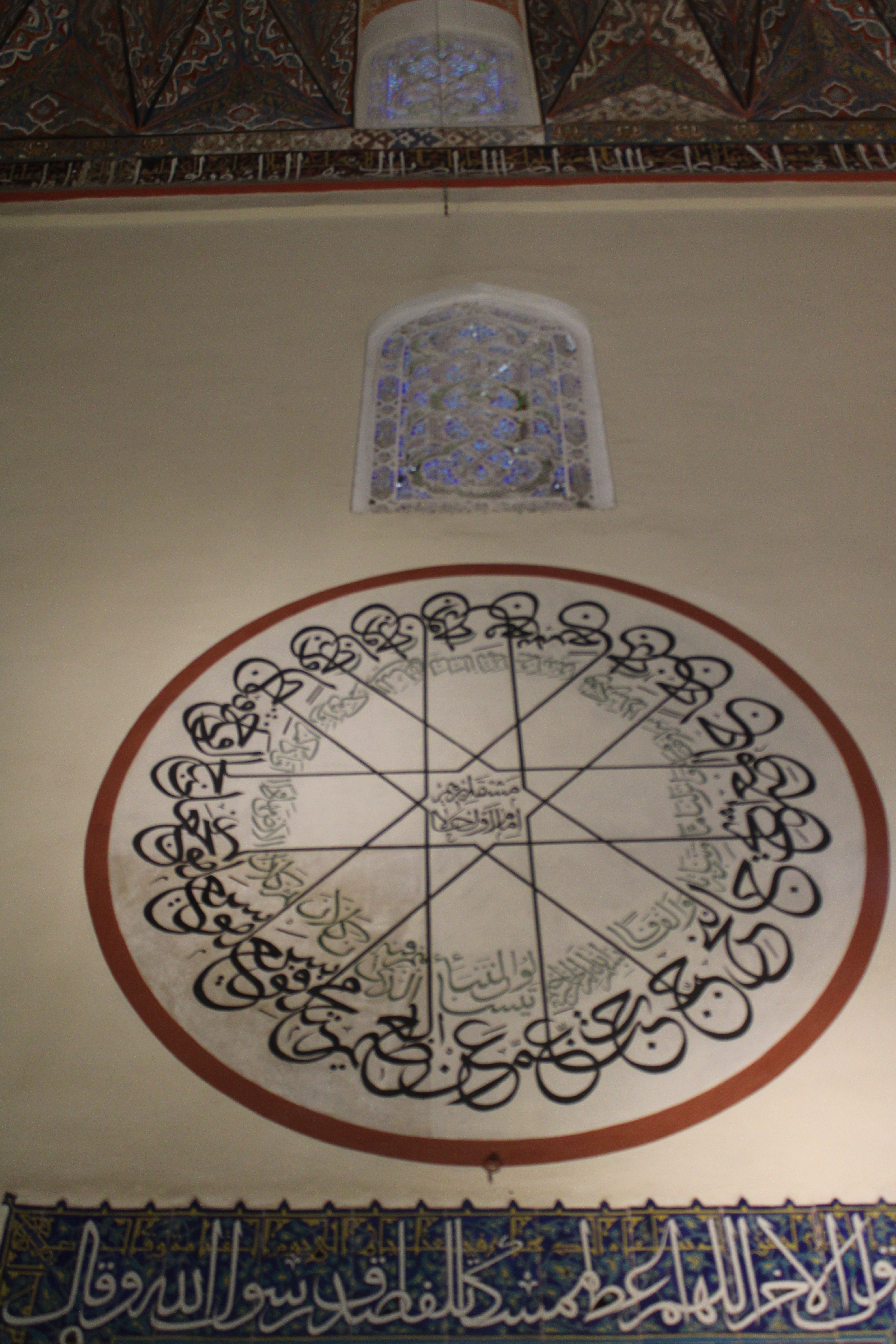
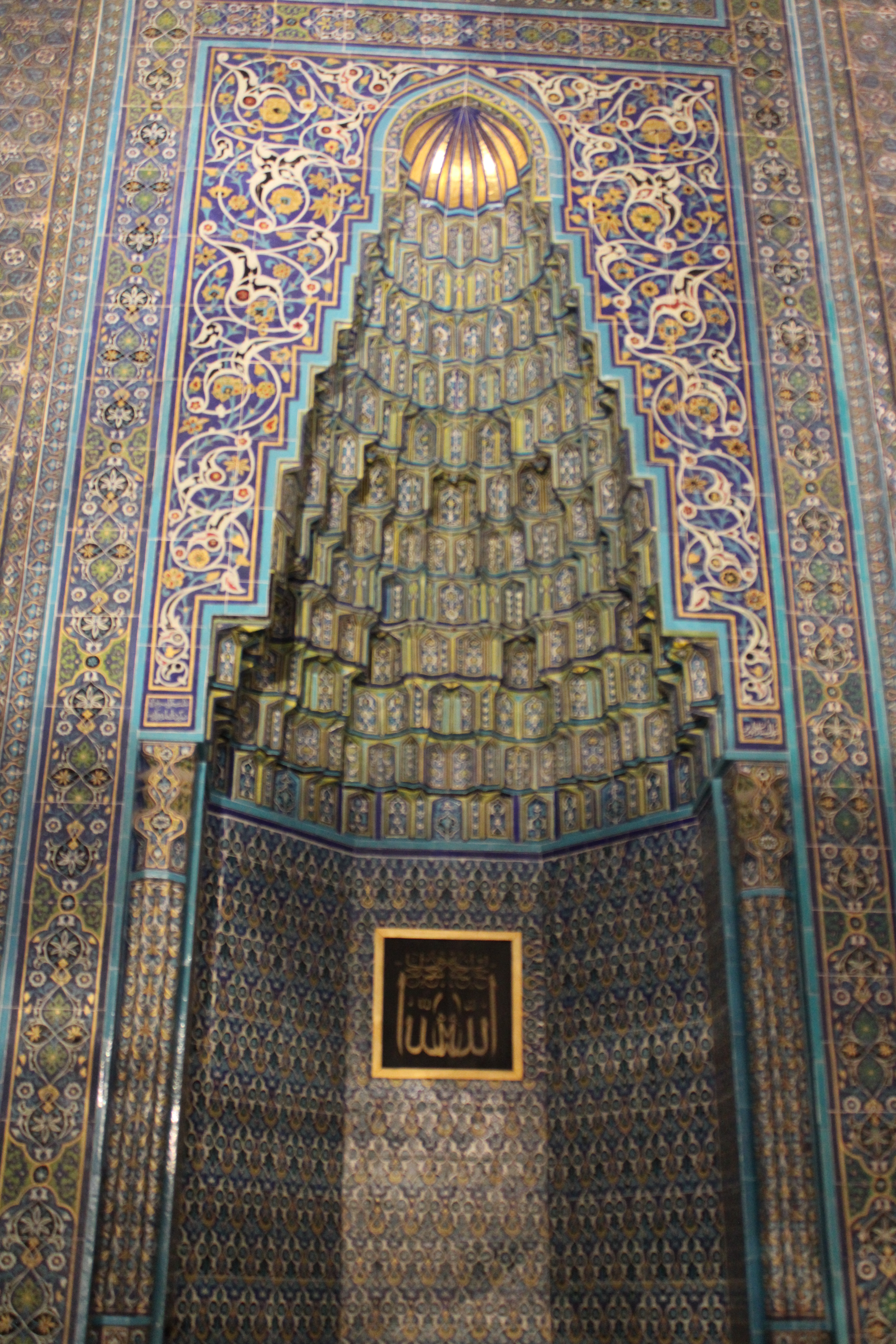
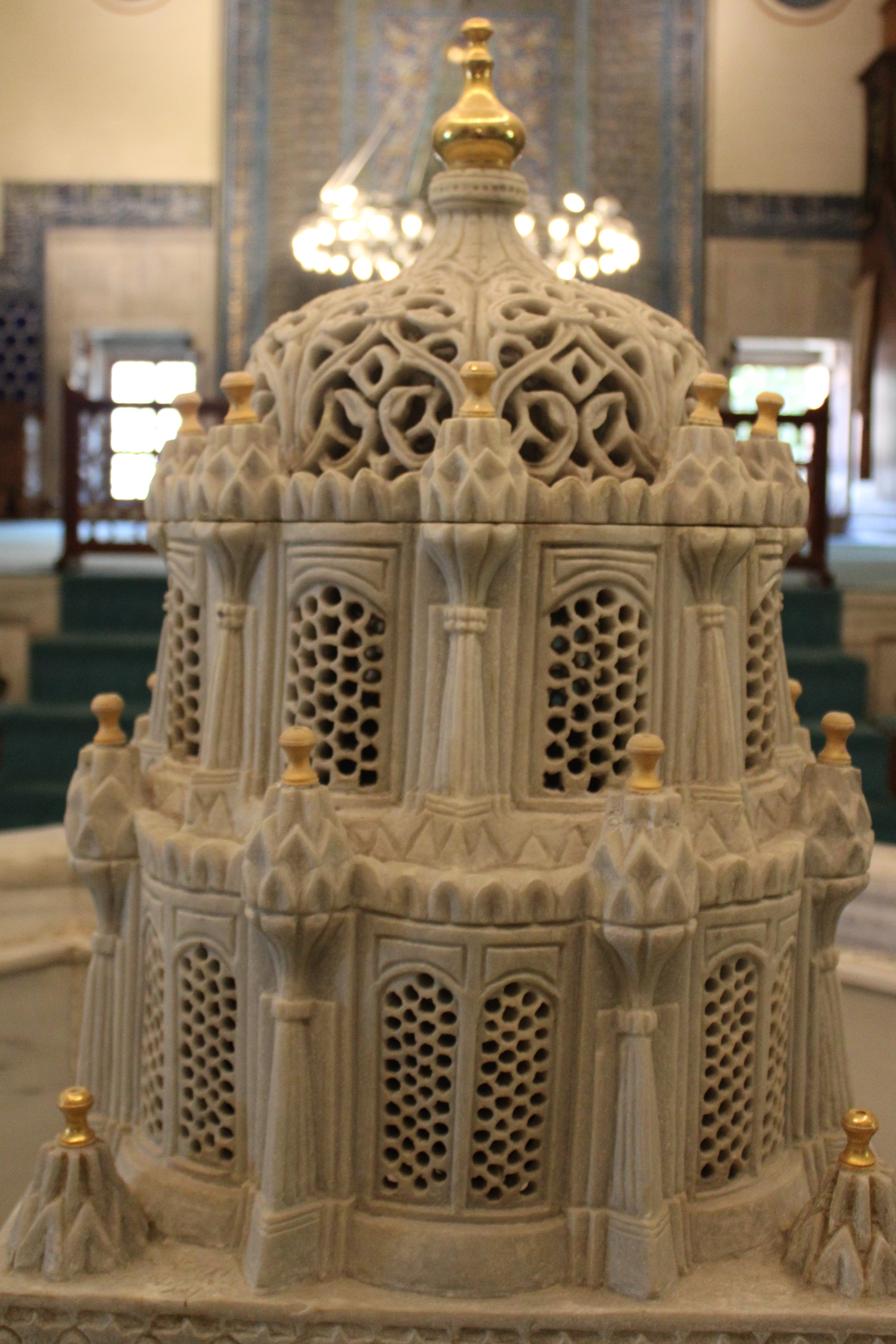
The entrance of the Mosque is a very fine example of Muqarna or honeycomb vaulting which is an important feature in Islamic architecture. Immediately after entrance and is the Office of the Mosque and the prayer hall is divided into two parts. One is lower part and other is upper part. One of the highlight of the lower part of the hall is the very beautifully carved Marble fountain in an octagonal pool. Today it is used as a Sebil. I also drank water from the Sebil. After climbing a few steps is the upper part. The mihrab is in the upper part of the hall. The whole hall is decorated with Arabic calligraphy depicting verses from the Qur’an. The mihrab itself is a fine example of architecture. The mihrab was constructed by experts which were called from Tabriz in Iran as clear from the inscription in Persian just above the mihrab. It reads “amal-i-ustadan-i-Tabriz” meaning the “work of the masters of Tabriz”.

Entrance of Yesil Cami

Entrance of Yesil Camii with Muqarna (Honeycomb Vault) at the top. Photo Credit & © Mohsin Aziz


Mihrab of Yesil Cami

Mihrab of Yesil Camii decorated with Green and Blue Iznik Tiles. Photo Credit & © Mohsin Aziz

Sebil inside Yesil Cami

Richly Carved Marble Fountain inside Yesil Camii. Photo Credit & © Mohsin Aziz


Calligraphy on stone inside Yesil Cami

A fine example of Calligraphy on Stone inside Yesil Camii. Photo Credit & © Mohsin Aziz

However there are two incidents that are the highlight of my Green Mosque visit. First is the honour of being invited to the Office of the Mosque and given a demonstration of Azaan. Mr. Recep Uyar is the Muezzin (the person who calls for prayer) of Yesil Camii since 2002. It was the effort of our tour guide Mr. Yilmaz who introduced me to Mr. Recep Uyar. Mr. Recep was kind enough to invite me and my family to the Office of the Mosque and give a demonstration of five different styles of Azaan. He called it Makaams and told us that this is how Azaan was given in Ottoman times. He recited for us the first line of Azaan i.e. Allahu Akbar in five different styles for each of the five daily obligatory prayers. As told by Mr. Recep, the styles for various prayers are as follows:
Fajr – Suboh or Sabahi
Zuhr – Ijaaz or Ejaaz
Asr – Raast
Maghrib – Qaseer
Isha – Ushaqi
Listening to him explain with passion and reciting the Azaan with so much love really made my day. It was one of the highlight of my Bursa tours. A short video of Mr. Recep Uyar giving Azaan in five different styles can be seen here:https://www.youtube.com/watch?v=xY7czSeQ_Z4
The second highlight of my Bursa tour was my meeting with the keeper of the washroom at the Yesil Camii Mosque. Since it was time for Zuhr (second obligatory prayer of the day prayed at noon time), we all decided to combine Zuhr and Asr  (third obligatory prayer fo the day prayed at afternoon) and pray at Yesil Camii itself before moving to our next stop in the city. I made wudhu (ablution) outside the Mosque. However my wife and daughter went to the washroom to make wudhu. Washrooms in Turkey are mostly paid. The same was true for the washroom outside the Mosque. I paid the required amount to the person sitting outside the washroom and my family went inside to make wudhu. In the meantime I realized that the person collecting money outside the washroom knew English (he was reading a book in English at that time). I struck conversation with him. The moment he knew that I am from India he asked me whether I know Safiur Rahman Mubarakpuri or not. Safiur Rahman Mubarakpuri has written a Sirah (Biography) of the Prophet Muhammad (Peace be upon Him) by the name of Al-Rahiq-Al-Makhtum (The Sealed Nectar). Fortunately I had read the book so I replied in affirmative. Safiur Rahma Mubarakpuri was from Azamgarh district in Uttar Pradesh. His next question was how far is Azamgarh from Delhi. When I told him that I am also from Azamgarh, he became very happy and started talking about other books which he was reading at that time. During the course of our conversation I was surprised to know that he not only knew English besides Turkish but he was quite fluent in Arabic as well. More surprising was that he had a large personal library. Since we had to go back to Istanbul same day and there were other places to visit in Bursa, I took his leave. Unfortunately I have forgotten his name but this fruitful meeting made me realize that we should never judge anybody by his appearance or work. Here was a man watching over a washroom in a Mosque but was not only well read but was investing his hard earned money in buying books on various subjects and had already created a decent library. I wish I remembered his name. I wish if only we had more people like him in our community. Whenever I think about him I feel really happy.

By this time we were really hungry as we had taken our breakfast quite early in Istanbul. It was decided to go to a popular restaurant. We ordered vegetable pizza and Iskender Kebap (that’s how Kabab or Kebab is pronounced and written in Turkey). Iskender Kebap is one of the well-known dishes of Bursa and takes its name from its inventor Iskender Effendi. It is layer of various ingredients. The base is pita bread. On the top of pita bread is thinly cut grilled lamb meet. It is further layered with tomato sauce and fresh yogurt. At the top is the piping hot melted sheep butter. The melted butter is poured over the dish at the table. It just melts in the mouth. Yeah I should not forget to mention that the vegetable pizza was one of the best that I have eaten anywhere so far. We ended our lunch with nice Turkish Tea.

After lunch we straight away proceeded to our last stop in Bursa i.e. Koza Han. It is situated in the Osmangazi area of Bursa between Bursa Grand Mosque and Orhan Mosque. Koza Han is century’s old silk market built in 1491. In recent times it was in news because of Queen Elizabeth II with Prince Philip visited the Koza Han in 2008. The Ottoman architecture of the market is spectacular. In old days it was market for Silk pods. Today it is one of the well-known Silk markets in Turkey. Bursa Silk is known all over Turkey for its high quality and finesse. Koza Han is a two storey market with a rectangular courtyard. There are 95 shops, all dealing with silk products. At the center of the courtyard is a beautiful fountain with water tank. There are steps which lead to a very small Mosque above the fountain. The Mosque-cum-fountain is surrounded by small restaurant famous for Turkish Tea in the charming cobbled stoned courtyard. Like any traditional market there is fair amount bargaining involved while buying silk at the market. After visiting several shops and lots of bargaining and some purchase was the time to return back to Istanbul.

Ottoman Era Mosque near Koza Haan

Ottoman Era Mosque near Koza Han at Bursa. Photo Credit & © Mohsin Aziz
Outside Koza Haan

Outside View of Koza Han. Photo Credit & © Mohsin Aziz


Arches inside Koza Haan

Arch inside Koza Han. Photo Credit & © Mohsin Aziz
 

Ground courtyard from first floor at Koza Haan

Mosque cum Fountain cum water Tank in the ground courtyard of Koza Han. Photo Credit & © Mohsin Aziz
The return journey was full of fun as our guide Mr. Yilmaz started telling stories of Mulla Nasruddin to my daughter. Stories of Mulla Nasruddin are quite popular in India and we all have heard his stories in our childhood. I always thought that Mulla Nasruddin is a fictional character but I was wrong. He was born in 1208 in Anatolia, Turkey. After finishing education he became Qazi (Judge) and held the post off and on till his death. He is very popular in Turkey and known as Nasreddin Hoca (pronounced as Hodja). Hoca means teacher/master in Turkish. Over the centuries his witty tales full of satire have traveled far and wide and today he is known not only in Turkey but all over the world. All his tails look like harmless fun with wit and humor but his parables always hold some underlying lesson of abiding wisdom. It is true that all the tales attributed to Mulla Nasruddin have not originated from him but are collective wisdom and humor of not only Turkey but so many countries from around the world. So much so that year 1996 was celebrated as the Nasredin Hoca Year by UNESCO. Mr. Yilmaz is a master story teller and we enjoyed his tales of Hoca Nasreddin and we did not realize when we reached our hotel in Istanbul. Thus ended one more well spent day in our lives.

Note: My tour agency for the Turkey tour was True Blue Tour, Istanbul. They arranged the car and the driver. Their website can be visited at http://www.truebluetour.com

For more information see the following:
Daily Sabah (26 April 2019) Turkish muezzin’s adhan recitation dazzles tourists. Available at: https://www.dailysabah.com/turkey/2019/04/26/turkish-muezzins-adhan-recitation-dazzles-tourists. Accessed on 12 March 2020
Wilco van Herpen (25 April 2012) Bursa’s Koza Han: A center for silk trade. Hurriyet Daily News. Available at: https://www.hurriyetdailynews.com/bursas-koza-han-a-center-for-silk-trade-19158. Accessed on 18 March 2020.
Scott Sherman & Bharati Sadasivam (22 Apr 2017) Bursa: Old is gold. Available at: https://www.livemint.com/Leisure/WnxxvqHjoVAuDTIhENhvWK/Bursa-Old-is-gold.html. Accessed on 21 March 2020.
Ugur, Ulu (17 September 2017) Turkey: Ottoman-ear silk bazaar draws visitors. Available at: https://www.livemint.com/Leisure/WnxxvqHjoVAuDTIhENhvWK/Bursa-Old-is-gold.html. Accessed on 19 March 2020.

Urdu Poetry and the times we are living in

Author: Mohsin Aziz

These days everyone is forwarding Bashir Badar’s famous Urdu couplet on WhatsApp groups and Facebook posts to highlight the concept of social distancing

  • Koi hath bhi na milaega, jo galey milogey tapaak se

         Ye nai mizaj ka shahar hai zara fasley se mila karo (Bashir Badar)

A friend of mine also forwarded the same on WhatsApp a few days ago. This led me to my diary of Urdu poetry (I keep a diary in my office. Whenever, I hear any Urdu couplet which I like, I immediately write it down). I found a lot of Urdu couplets which deal with various concepts that we are getting to know for the first time. It is true that these couplets were not written to describe the environment created by Corona Virus. However, it is also true that some of these Urdu couplets were indeed written to explain the Plague which humanity has witnessed before.

Doctors are advising us to stay at home as much as possible to reduce the possibility of catching the virus. Here are some of the Urdu couplets which I found to be relevant to the concept of not venturing out:

  • Yunhi besabab na phira karo koi shaam ghar bhi raha karo

          Ye ghazal ki sachi kitab hai isey chupkey chupkey padha karo (Bashir Badar)

This was written in a different context but the first line perfectly describes the current situation. Similarly following couplet also describes the situation in other words

  • Khudgharz hota to hujuum hota sath

         Mukhlis huun is liye to tanha hoon (Unknown)

  • Meri tanhai ko mera shouq na samajhna

         Bohot pyar se diya hai ye tuhfa kisi ne (Unknown)

Starting with China, sooner or later every major country has been forced to announce lockdown. The once bustling cities and their markets and roads are empty. Who would have thought that the busiest streets in the world would be deserted and biggest of the shopping malls and markets would be closed to contain the disease? None of us have seen anything like this before. So far there is no vaccine or medicine for Covid-19. The only way to control and contain is to close and cut off the cities from the rest of the world. I found some of the Urdu couplets beautifully describing the situation. For example:

  • Ajeeb marz hai jiski dawa hai tanhai

         Baqai shahar hai ab shahar ke ujadney main (Unknown)

  • Aur kis mausam men jab ta.un hai phaila hua
    Zarra zarra hai vaba ke ḳhauf se simta hua (Unknown)
  • Bazaar hain khamosh to galiyon pe hai sakta

          Ab shahar main tanhai ka dar bol raha hai (Ishaq Virdag)

  • Basti basti parbat parbat dahshat ki hai dhoop ziya

         Charon janib wirani hai dil ka ek wirana kya (Ahmad Ziya)

  • Sehra ko bohot naaz hai wirani pe apni

         Waqif nahin shayad merey ujdey hua ghar se (Khumaar Barabankwi)

  • Rastey hain khuley hue sarey

         Phir bhi ye zindagi ruki hui hai (Unknown)

One of the major cultural casualty of the Corona Virus is the handshake. There are notices in offices and every guideline on stopping the virus highlights the importance of avoiding handshake. Already there are articles being written on whether Corona Virus is the end of handshake. Besides Bashir Badar’s couplet which I quoted in the beginning, there are many other relevant ones which describe either the fear which forces people to keep distance from each other or which forces them not to shake hands. Here’s a sample:

  • Ajeeb daur aya hai zamaney main

        Doori rakhni padegi rishtey nibhaney main (Unknown)

  • Afsos ye waba ke dinon ki mohabbatain

        Ek dusrey se hath milaney se bhi gaye (Sajjad Baloch)

  • Ye jo milatey phir rahey ho tum har kisi se hath

         Aisa na ho ki dhona padey zindagi se hath (Javed Saba)

  • Sabhi ek dosrey se chhip rahey hain

        Waba ….. basti main aisi agayi hai (Unknown)

  • Qurbatain lakh khoobsurat hon

         Duriyun main bhi dilkashi hai achhi (Ahmad Faraaz)

  • Dil to pehley hi juda tha yahan basti walon

          Kya qayamat hai ke ab hath milaney se gaye (Unknown)

Despite all the doctors telling us to avoid handshake, there still are friends who insist on the handshake. I was surprised to find couplets on this too. They were written in a different context but fit the bill. For example:

  • Merey dushman ko zarurat nahin kutch karney ki

         Is se acha to merey yaar kiye jatey hain (Jaleel Aali)

The following couplets also describes the situation in a different way

  • Ye kahkey usney mujhey makhmasey main dal diya

         Milao hath agar waqai mohabbat hai (Unknown)

  • Marney waley to khair bebas hain

         Jiney waley kamaal kartey hain (Khalilur Rehman Raz)

  • Haal pucha na karey hath milaya na karey

         Main is dhoop main khush hoon koi saya na karey (Kahsif Hussin Ghair)

While there are people who are still not ready to give up the handshake, there are others who are genuinely worried about talking to others face to face, lest they are infected.

  • Anjuman main ye meri khamoshi

         Burdbari nahin hai dahshat hai (John Elia)

However, with situation getting worse by the day, nobody is making fun of those who are avoiding to meet others or shake hand. A month back, anybody following the guidelines was seen by many as weak hearted. Not anymore. Everybody has started taking it seriously and nobody is now embarrassed not to shake hand or maintain a safe distance while talking to each other. The following couplet perfectly sums up the changed mood of the society.

  • Ab nahin koi baat khatrey ki

         Ab sabhi ko sabhi se khatra hai (John Elia)

There are some who are feeling stressed sitting under lockdown while there are others who are seeing too much news and getting further stressed out. As World Health Organization has suggested, we should not read or listen too much about what’s happening all over the world. This may further stress us.

  • Khwab ki tarah bikhar janey ko dil chahta hai

          Aaisi tanhai ki mar janey ko ji chahta hai (Iftikhar Arif)

  • Har ek jism mian maujud hashtpa ki tarah

         Waba ka khauf hai khud bhi kisi waba ki tarah (Saud Usmani)

One aspect of the lockdown has been urge of people to hoard foodstuff. So much so that in some places, there have been fighting between people at shopping stores. This one describes the situation very well.

  • Fikr to hai apni zaat ki bas alam hai nafsa nafsi ka

         Kisi ko farq nahin padta ab jiye koi ya marey koi (Manabil farouqi)

While a lot of people have succumbed to this disease there are many who had to face the situation of dying without their loved ones around them. See Mirza Ghalib’s take on this

  • Padiye gar bimaar to koi na ho timaardar
    Aur agar mar jaaiye to nauha-ḳhwan koi na ho (Mirza Ghalib

The people who are at the frontline in this fight against the virus are doctors and paramedical staff. However, despite their best of efforts they cannot save everybody. Sometimes doctors have to take painful decision of choosing between patients because of lack of resources. The most famous and most oft quoted Couplet on benefactors (usually referred to as masiha can be used as a synonym for doctors and paramedics here) is the one by the most often quoted by master poet Mirza Asadullah Khan Ghalib which goes as follows:

  • Ibn Mariam hua karey koi

         Merey dukh ki dawa karey koi (Mirza Ghalib)

Besides there are others some of which are quoted here:

  • Mehrbani charasazon ki badhi

         Jab badha darman to bimari badhi (Mubarak Azimabadi)

  • Kaun hai jo nahin hai hajatmand

         Kiski hajat rawa karey koi (Mirza Ghalib)

  • Bedum huye bimar dawa kyon nahin detey

         Tum achey masiha ho shifa kyon nahin detey (Faiz Ahmad Faiz)

  • Kya suna.en jan-ba-lab qaumon ki bimari ka haal

         Dard badhta hi gaya juun juun dava karte rahe (Unknown)

Doctors being at the frontline also means that many are themselves getting infected. There have been reports from Italy to China to India where the doctors and nurses have caught the virus while attending to the patients. Some have even lost their lives in the process. Here are few couplets which describe the situation

  • Charagar bhi jo yun guzar jain

         Phir bimar kiskey ghar jain (Unknown)

However, the most affected section of the society is the poor. It is a fact that the lockdown which has been announced in many countries has hit the poorest the hardest. Already there is news coming of poor dying of hunger because they cannot go out and work and don’t have enough at home to sustain them. The following couplets describe their pain and suffering

  • Sab pareshan hain ki aḳhir kis vaba men vo mire
    Jin ko ġhurbat ke alava koi bimari na thi
    (Hasan Naim)

But this is life. As long we are alive, we have to face one problem or the other. According to Ghalib:

  • Ghamey hasti ka asad kis se ho juz marg ilaaj

         Shama har rang main jalti hain sahar honey tak (Mirza Ghalib)

There is every chance that as it enters stage three of community spread, there will be hardships before it is controlled

  • Ibtedaye ishq hai rota hai kya

          Agey Agey dekhiye hota hai kya (Mir Taqi Mir)

Yes, these are difficult times but this too shall be over. As a poet describes it:

  • Hamesha ek hi alam main hona, ho nahin sakta

         Musalsal ka kahin akar badalna bhi zaruri tha (Muneer niyazi)

It is a lesson for us to realise how vulnerable we are as human beings. This has affected the richest of the countries with the best of the healthcare systems. It’s time to reflect on the purpose of our existence and understand that there is a Supreme Power beyond the super powers of this world who runs the show

  • Hai koi to jisney jahaan hila ke rakh diya

         Lagta tha hamary bin pattey na hilen (Unknown)

We don’t have any choice but to repent and go back to the Creator of the Universe asking for forgiveness, to help us come out of this huge calamity

  • Koi chara nahin dua ke siwa

         Koi suntan nahin khuda ke siwa (Hafeez Jalandhari)

  • Na charagar ki zarurat na kutch dawa ki hai

         Dua ko hath uthao ki gham ki raat hai (Rajender Krishan)

Many of us are wondering why our prayers are not being heard. May be this is the reason

  • Abhi dilon ki tanabon main sakhtiyaan hain bohot

         Abhi hamari dua main asar nahin aaya (Aftab Hussain)

For those who has no time and were always wondering when will they get some respite from their busy schedules and spend some me time, the poet has to say this:

  • Ae merey lamhai naraz kabhi mil to kahin

         Is zamaney se alag hokey guzarun tujhko (Ashgar Abid)

One way of restricting any epidemic (or pandemic) is to isolate those who are affected and not allowing them to move out. Still there are people moving out from their houses as well as moving from one country to another, thus spreading the virus. The following couplet describes the situation and offers advice, that:

  • Jahan jo tha wahin rahna tha usko

         Magar ye log hijrat kar rahey hain (Liyaqat Jafri)

For those of us who are fortunate enough to use the opportunity to spend time with their families and take care of others in these times may echo Mirza Ghalib once all this is over:

  • Ji dhondta hai phir wohi fursat ke raat din

        Baithey rahen tasawwur e janan kiye hue (Mirza Ghalib)

But till that time comes we have to take all precautions as prescribed by doctors and health experts and cut off ourselves from others as much as possible. Again it is Ghalib who are something to say:

  • Rahiye ab aisi jagah chal kar jahan koi na ho
    Hum-suḳhan koi na ho aur ham-zaban koi na ho
    Be-dar-o-diwar sa ik ghar banaya chahiye
    Koi hum-saya na ho aur pasban koi na ho

These are some of the Urdu couplets which I found relevant to the current situation. Most of the poets names I knew but there are quite a few couplets for which I did not know the name of the poet. Wherever I have written unknown means I don’t know the name of the poet. If any of the reader knows the name of the creator of these couplets, kindly tell me so that I can update. And yes there are hundreds of more such couplets proving again that very few languages in the world can match the subtlety and diversity of topics discussed in Urdu literature and poetry. It is not without reason that Daagh Dehlevi said:

Urdu hai jiska naam hamin jantey hain Daagh

Saarey jahan main dhoom hamari zubaan ki hai

(Daagh Dehlevi)


The Menace of Corona Virus: This too shall pass

It was on 31 December 2019 that China communicated to the World Health Organisation (WHO) about an unknown virus in its industrial city of Wuhan. The world did not take note of this communication. Even in China the belief was that it was recurrence of SARS Virus. However, by January 7, 2020, China ruled out the possibility of SARS and identified a new strain of Coronavirus. Coronavirus is a form of virus which causes a range of disease ranging from mild fever to severe pneumonia. The new virus was called 2019-nCov (now called Covid-19) popularly known as Corona Virus.

On January 11, 2020 China announced first death from the new virus. On January 23, 2020, Wuhan was put on Quarantine. By the beginning of February 2020, several countries started reporting their first cases. Italy was among them. It was on 22 February 2020 that Italy reported its first two deaths. As of today 25 March 2020, there are reportedly more than 400000 cases and 19000 deaths and Italy has surpassed China by huge margin (in fact more than double of China) in number of reported deaths. On 11 March 2020, WHO was forced to declare Covid-19 as pandemic. On 24 March 2020, International Olympic Committee also declared postponing the Olympics beyond 2020 to 2021.

Experts are worried about exponential curve when the cases start doubling almost every day. In the beginning it is still manageable but within a month it becomes almost unmanageable as the experience of Italy shows. This curve can be flattened by taking certain measures such as social distancing. It can be done by avoiding social spaces, keeping distance from each other and avoiding physical contact like handshake.

Strict measures have been put in place by almost all the counties. While some countries have managed to control the spread of disease by putting in control measures and information access to citizens, others were slow in taking decisions. Countries which were slow in taking tough decisions are now forced to take them albeit after the disease has already spread. Then there are places like Hong Kong which took tough measures early on and were able to control the spread but let their guard down a little bit early and saw sudden spike in cases.

Every person is important in this fight against this deadly virus as exemplified by now famous “Patient 31” from South Korea. One of the few affected countries which was able to check the spread of virus is South Korea. The government of South Korea was quick to react. The lessons learnt from MERS came in handy. South Korea tested far more people than any other country. Geo tagging of people who were tested positive was done. Laws were immediately changed. The citizens also cooperated and were ready to trade off some personal liberty for bigger social cause for the time being. The experience of South Korea also highlighted the importance of taking each case seriously. The number of people affected by the virus were around 30. Then came in the Patient Number 31 and by the time she was identified and her weekly routine traced back the number of cases increased more than 50 times within a week and the government was forced to declare highest level of medical emergency in the country. All this because she did not practice social distancing. We have to remember that the Covid-19 has very big ego. It will not come to your house unless you go out and invite it in. However, practicing social distancing is sometimes almost next to impossible. It is possible for upper class or upper middle class and middle class to practice social distancing. It is almost impossible in many poor counties and slums. The population density of slums is way too high for social distancing to be practical. Often 5-10 persons live in one room making social distancing impossible.

Every news channel and every newspaper is talking about it. People are learning new terms like Pandemic, Endemic, Lockdown, Curfew, Quarantine, Community Spread, Super Spreader, Social Distancing, Hazmat Suit etc. The pandemic has affected the whole world. Its affect is being felt in almost every aspect of life. It has tested and exposed medical preparedness of countries. It has exposed the disaster management preparedness of countries. One of the first to affected were schools as they were the first one to be closed. Suddenly teachers, kids and parents learned more about e-learning  in less than a week then what they had learned in their lifetime. It has also led to number of conspiracy theories which are flying around like anything.

Businesses have been severely affected. Supply chains have gone haywire. Production has come to a halt in many places and people have already started losing jobs. However, the biggest sufferer is tourism and allied industries like airlines, hotels, restaurants, tourist guides etc. There are going to be a number of bankruptcies in Airlines industry (flyby of UK is an early example). Stock markets have crashed all over the world. The GDP growth is going to be negatively impacted in each and every country. The biggest losers will be small and medium businesses and daily wagers. Homeless people are particularly vulnerable. Desperate times call for desperate measures. The United States Government is planning a 1 to 2 Trillion US Dollar intervention to help businesses sustain. It is equal to 5% of US GDP. The world has not seen such unprecedented government intervention, perhaps, except during 1930’s recession.

Central banks of more than 50 countries as of today have cut interest rates to support businesses. The European Unions is taking unprecedented fiscal steps to help countries overcome the pandemic. It has taken steps to suspend rules on public deficit, thus allowing countries freedom to inject liquidity into the economy as required.

While covid-19 has brought compassion of common people all over the world to the fore, on the other hand it has also brought fear resulting in racism and discrimination to raise its ugly head. Chinese in Germany and France have reported facing racist slurs and have been spat upon in many cases. So much so that in France, a citizen of Chinese origin has started a hashtag #JeNeSuisPasUnVirus which means “I am not a virus”. In India also people from north east have recently faced racist comments such as being called Corona in other parts of India. This is shameful and must immediately stop. On the other hand, we have beautiful stories of people helping total strangers. Who can forget the example of Italian Priest, Don Giuseppe Berardelli, who gave up his ventilator to a younger patient and himself embraced death. It is such stories which restore one’s faith in humanity and gives hope that this too shall pass.

There have been many unintended outcomes of the present crisis. It has forced countries to work together. Japan was one of the first countries to supply medical support to China although they have troubled past and are bitter rivals in many ways. One unlikely positive outcome of the lockdown is the lowering of pollution levels in places previously notorious for high pollution levels. It has allowed families to spend time together which at many places was not possible in the busy schedules. It is forcing people to find new methods and adopt new technologies to work and help each other. More importantly it has made the whole world to realise that at the end we all are equal. It does not matter you are citizen of which country, profess which faith, how rich or poor you are. It has brought everybody at the same level.

Important thing for us is not to panic, help the poor and the needy as much as possible, appreciate family and friends, take government instructions seriously and follow them and last but not least, ponder on the purpose of life beyond money, saving and investment. This too shall pass, Insha’Allah.

Reference:

Aamir Altaf (18 March 2020) ‘You are Coronavirus’: Students From Northeast India Face Bigotry Over Pandemic. Available at: https://livewire.thewire.in/campus/you-are-coronavirus-students-from-northeast-india-face-bigotry-over-pandemic/. Accessed on 25 March 2020.

Al Jazeera.Com (2020) Timeline: How the new coronavirus spread. Available at: https://www.aljazeera.com/news/2020/01/timeline-china-coronavirus-spread-200126061554884.html. Accessed on 22 March 2020.

Ella Torres (13 March, 2020). Backlash against Asians could hinder efforts to contain coronavirus, expert saysABC News (2020). https://abcnews.go.com/US/backlash-asians-hinder-efforts-coronavirus-expert/story?id=69556008

Emiko Jozuka and Serenitie Wang (26 February 2020) China and Japan’s relationship is thawing in the time of coronavirus. Available at: https://edition.cnn.com/2020/02/25/asia/japan-china-coronavirus-enemies-to-friends-hnk-intl/index.html. Accessed on 28 February 2020.

Harry Stevens (14 March, 2020). Why outbreaks like coronavirus spread exponentially, and how to “flatten the curve”. Available at: https://www.washingtonpost.com/graphics/2020/world/corona-simulator/. Assessed on 23 March 2020.

India Today (24 March 2020) Verbally abused, spat at, harassed: Northeastern citizens come under attack amid coronavirus panicAvailable at: https://www.indiatoday.in/india/story/verbally-abused-spat-at-harassed-northeastern-citizens-come-under-attack-amid-coronavirus-panic-1658826-2020-03-23. Accessed on 25 March 2020.

International Olympic Committee (24 March, 2020) Joint Statement from the International Olympic Committee and the Tokyo 2020 Organising Committee. Available at: https://www.olympic.org/news/joint-statement-from-the-international-olympic-committee-and-the-tokyo-2020-organising-committee. Accessed on 25 March 2020.

James Griffiths (24 March, 2020). Hong Kong appeared to have the coronavirus under control, then it let its guard down. Available at: https://www.msn.com/en-us/news/world/hong-kong-appeared-to-have-the-coronavirus-under-control-then-it-let-its-guard-down/ar-BB11z2Ld?ocid=spartanntp. Accessed on 24 March 2020.

Japan Times (March 2020) How one patient turned South Korea’s virus outbreak into an epidemic. Available at: https://www.japantimes.co.jp/news/2020/02/27/asia-pacific/science-health-asia-pacific/south-korea-coronavirus-epidemic/#.XnnDeW5uKUk. Accessed on 24 March 2020.

Kelly Kasulis (3 March, 2020)’Patient 31′ and South Korea’s sudden spike in coronavirus cases. Available at: https://www.aljazeera.com/news/2020/03/31-south-korea-sudden-spike-coronavirus-cases-200303065953841.html. Accessed on 24 March 2020.

Lora Jones, David Brown & Daniele Palumbo (20 March 2020). Coronavirus: A visual guide to the economic impact. Available at: https://www.bbc.com/news/business-51706225. Accessed on 24 March 2020.

Megha Rajagopalan (4 March, 2020) Men Yelling “Chinese” Tried To Punch Her Off Her Bike. She’s The Latest Victim Of Racist Attacks Linked To Coronavirus. Available at: https://www.buzzfeednews.com/article/meghara/coronavirus-racism-europe-covid-19. Accessed on 4 March 2020.

Ministry of Health, Sultanate of Oman (2020). Available at: https://www.moh.gov.om/en/corona. Accessed on 23 March 2020.

Ryan W. Miller (24 March 2020) Italian priest with coronavirus who gave his ventilator to younger patient has reportedly died. Available at: https://www.usatoday.com/story/news/world/2020/03/24/covid-19-italian-priest-who-donated-his-ventilator-has-reportedly-died/2906351001/. Accessed on 24 March 2020.

Vaihayasi Pande Daniel (24 March2020)’How can there be social distancing in slums?’. Available at: https://www.rediff.com/news/special/how-can-there-be-social-distancing-in-slums/20200324.htm. Accessed on 24 March 2020

World Health Organisation (12 March 2020). WHO announces COVID-19 outbreak a pandemic. Available at: http://www.euro.who.int/en/health-topics/health-emergencies/coronavirus-covid-19/news/news/2020/3/who-announces-covid-19-outbreak-a-pandemic. Accessed on 12 March 2020.

From CAB to CAA

The Rajya Sabha on Wednesday i.e. 11 December 2019 passed the Citizenship Amendment Bill or CAB. It was previously passed by the Lok Sabha on Monday i.e. 2 December 2019. The bill was signed by the President of India on Thursday i.e. 12 December 2019, thus making it Citizenship Amendment Act or CAA.

According to the act, the members of Hindu, Sikh, Buddhist, Jain, Parsi and Christian communities who have come from Pakistan, Bangladesh and Afghanistan till 31 December 2014 citing persecution shall not be treated as illegal immigrants but given Indian Citizenship. The six communities identified in the Act will be given Indian Citizenship after 5 years. Earlier the duration was 11 years. The Act also gives immunity to illegal immigrants if they are facing legal cases. However, the act will not be applicable to the Assam, Meghalaya, Mizoram and Tripura as included in the schedule six of the Constitution. The Act will also not apply on areas covered under Inner Line Permit or ILP as notified under Bengal Eastern Frontier Regulation, 1873.

A large section of the population in the states of Assam and Tripura are opposing the act saying that the act nullifies the provisions of the Assam Accord of 1985. They also fear that if citizenship is granted to illegal Bengali speakers (both Hindu and Muslim), it will undermine their culture and language. It is pertinent to mention here that the Assam Accord fixed March 24, 1971 as the cutoff date for deportation of illegal immigrants irrespective of religion. The Assam Accord was signed by the Government of India, Government of Assam, All Assam Students’ Union (AASU) and Assam Gana Sangram Parishad in 1985 after years of protests in Assam. The present protests in Assam are only against CAA and not against National Register of Citizens or NRC.

Slowly the protests spread to other parts of the country. However, the tipping point came with police assault on the students of Jamia Millia Islamia University in Delhi and subsequently on Aligarh Muslim University at Aligarh. The reports point out the brutality of police on the defenseless students of both the Universities. There are claims and counter claims from the students and the police. Both the educational institutions have been closed till January 5, 2020. Uddhav Thackeray has on record compared the police attack on Jamia Millia Islamia to the Jallianwala Bagh massacre. A fact finding team by human rights activist, Harsh Mander, described the attack on the students of Aligarh Muslim University as more brutal than even Jamia. There has been a long list of colleges and universities where protests by students have been registered against police assault on Jamia Millia Islamia and Aligarh Muslim University. Some of the prominent Universities that have joined the protest against CAA are Madras University, Punjab University, Pondicherry University, Nadwatul Ulama, Punjabi University, Osmania University, Jawaharlal Nehru University, Delhi University, Jadavpur University, Indian Institute of Technology (Madras), Mumbai University, Indian Institute of Technology (Mumbai), Tata Institute of Social Sciences, Indian Institute of Management (Bangalore), Indian Institute of Management (Ahmedabad), Aliya University etc.

NRC was first done in Assam as per the Assam Accord. The whole process was monitored by the Honorable Supreme Court of India. It was Assam specific exercise. However, the results of the NCR were not to the liking of many and hence the CAB (now CAA) was brought in. Yes, standalone CAA may not be damaging to a section of Indian population. However, when used in conjunction with NCR it becomes lethal. It would allow the filtration of Muslims because NCR assumes one to be a non-citizen and it is left to the person to prove that he / she is a citizen. However, the CAA allows Citizenship to everybody except Muslims. Even otherwise, prima facie, the CAA is against the provisions of the Constitution of India, particularly, Article 14. Article 14 of the Constitution of India states that “The State shall not deny to any person equality before the law or the equal protection of the laws within the territory of India”. By leaving out the Muslims from its net, it contradicts this basic principle of the Constitution. The Honorable Supreme Court of India has accepted the plea of concerned citizens to look into the legality of the Act. However, chances that it would be declared null and void by the court look slim. In the meantime, the Union Cabinet has approved to create a National Population Register (NPR). Many argue that NPR is nothing but old wine in new bottle. It is another method of implementing NCR by a different name.

It is worth remembering that the Honorable Supreme Court of India has refused to stay the implementation of CAA 2019. However, it has issued notice to the central government on a batch of petitions challenging the constitutional validity of the Act. A bench headed by the Chief Justice of India said that the matter will be heard in January when the apex court opens after winter break. Now all eyes are on the Highest court of the land to bring closure to the matter.

References and for more information, please see:

http://timesofindia.indiatimes.com/articleshow/72498580.cms?utm_source=contentofinterest&utm_medium=text&utm_campaign=cppst

India Today (2019, December 12) What is Citizenship Amendment Bill: All you need to know about CAB. Available at: https://www.indiatoday.in/india/story/citizenship-amendment-bill-all-you-need-to-know-about-cab-1627516-2019-12-11. Accessed on 12 December 2019

Economic Times (2019, December 2) Citizenship Amendment Bill passed in Lok Sabha. Available at: https://economictimes.indiatimes.com/news/politics-and-nation/lok-sabha-passes-citizenship-amendment-bill-2019/articleshow/72447352.cms. Accessed on 12 December 2019.

Times of India (2019, December 12) Citizenship (Amendment) Bill gets President’s accent, becomes Act. Available at: https://timesofindia.indiatimes.com/india/citizenship-amendment-bill-gets-presidents-assent-becomes-act/articleshow/72498580.cms. Accessed on 13 December 2019

The Wire (2019) ‘More Brutal Than Even Jamia’: AMU Fact Finding Report Accuses UP Police of Violence, Islamophobia. Available at: https://thewire.in/government/amu-caa-protests-up-police. Accessed on 23 December 2019.

Apurva Vishwanath. & Kunain Sheriff M. (2019, December 23). Explained: What NRC+CAA means to you? Available at: https://indianexpress.com/article/explained/explained-citizenship-amendment-act-nrc-caa-means-6180033/. Accessed on 23 December 2019.

https://timesofindia.indiatimes.com/india/wont-roll-out-cab-2-non-bjp-states/articleshow/72499408.cms

https://globalnews.ca/news/6301241/india-protests-citizenship-bill-explainer/

https://indianexpress.com/article/explained/explained-how-to-be-a-citizen-of-india-earlier-now-6165960/

Times of India (2019, December 18) Available at: https://timesofindia.indiatimes.com/india/sc-decides-to-examine-constitutional-validity-of-citizenship-amendment-act/articleshow/72864701.cms. Accessed on 18 December, 2019

Gulf News (2019, December 18). India: Supreme court issues notices to Centre on petitions challenging CAA validity. Available at: https://gulfnews.com/world/asia/india/india-supreme-court-issues-notices-to-centre-on-petitions-challenging-caa-validity-1.1576650901831. Accessed on 19 December 2019.

https://en.wikipedia.org/wiki/Citizenship_(Amendment)_Act,_2019

https://en.wikipedia.org/wiki/Citizenship_(Amendment)_Act,_2019

https://www.nationalheraldindia.com/blog/blog-questions-i-would-like-to-put-to-honorable-amit-shah-on-caa-and-nrc-2

https://www.nationalheraldindia.com/blog/blog-questions-i-would-like-to-put-to-honorable-amit-shah-on-caa-and-nrc-2

https://timesofindia.indiatimes.com/india/granting-citizenship-is-centres-call-states-have-no-say-experts/articleshow/72564874.cms

https://www.indiatoday.in/mail-today/story/shaken-and-stirred-from-punjab-to-tamil-nadu-caa-fire-singes-india-1629201-2019-12-18

https://thewire.in/politics/rajasthan-opposition-citizenship-amendment-act-ashok-gehlot

https://www.thehindu.com/news/national/kerala/rival-fronts-bury-differences-join-hands-against-caa/article30324285.ece

https://www.thehindu.com/news/national/p-chidambaram-interview-citizenship-amendment-bill-is-a-clear-signal-a-blunt-signal-to-muslims/article30289448.ece?utm_source=taboola

https://www.thehindu.com/news/national/scientists-scholars-call-to-scrap-citizenship-bill/article30259403.ece?utm_source=taboola

https://www.thehindu.com/news/national/javed-akhtar-aparna-sen-swami-agnivesh-and-others-flay-cab-nrc/article30271214.ece?utm_source=taboola

https://www.thehindu.com/news/national/citizenship-law-discriminatory-against-muslims-un/article30300560.ece?utm_source=taboola

https://www.thehindu.com/news/national/citizenship-amendment-bill-united-states-legislators-express-concern/article30290519.ece?utm_source=taboola

https://www.thehindu.com/specials/understanding-the-citizenship-amendment-bill-2019/article30283717.ece?utm_source=taboola

https://timesofindia.indiatimes.com/entertainment/hindi/bollywood/news/dont-be-silent-dont-be-violent/articleshow/72862116.cms

https://timesofindia.indiatimes.com/entertainment/hindi/bollywood/news/dont-be-silent-dont-be-violent/articleshow/72862116.cms


Gravestones and Sebils of Istanbul

Before visiting Turkey, I had no idea about the importance of either gravestones or sebil in the history and culture of Turkey. However, while strolling on the streets of Istanbul, particularly in Sultanahmet and Eyup districts, I saw a lot of graves with unique tombstones. Similarly, I saw a lot of Sebils, some still functional, some dysfunctional, some broken and some with great design depicting the architecture of their times.

Gravestones

Most schools of legal interpretation in Islam do not look favorably either at concrete grave or gravestones. However, during my recent visit to turkey I found out that gravestones are an integral part of Turkish culture. In turkey there is a whole culture and tradition of tombstone art. Most of them are like a mini biography of the diseased. According to the French Novelist, Andre Malraux, Ottoman tombstones make “death warm up to life”

One of the most iconic is the tombstone of Ibrahim Pasha who died in 1725. He was a Kaptan i Derya (Naval Captain). His tomb shows a captain with an anchor, rope and broken mast. It is symbolic of captain entering a ship that will take him to his destination in next life the way it took him to his destination in this life.

The graves of different Sufi orders and their dervishes can also be distinguished from different colour of clothes and coverings on the grave. For example, round hat on the gravestone signifies Sufi of Bektashi order. Different colours are also used to signify different professions such as green colour is used for scholars and leading scientists. Similarly, broken rosebud signifies a young female.

It’s not only the design of the gravestone and the art on it but what is written is also important. Sociologists and historians can decipher a lot from the writings on gravestones. Here is a small sample of some of written words on the gravestones of Istanbul.

  • See, what these gravestones tell you,

          One lie ended here and one truth has begun


  • “Oh visitor, this young women lying beneath this stone was one of those cleanest, purest and smartest. The fate laid her on the soil that you are beholding now. This rare flower, which death picked when she was young, was one of the finest examples of intellect and chastity. Recite Al Fatehah for her innocent soul. 26 January, 1910. Wednesday.”


  • “It is He who is permanent

         Come, oh my Effendi, fix your gaze on my gravestone

         If you are smart enough, act wisely

        I used to wander all around, see what happened to me?

       I died in the end, a gravestone erected upon me”


  • I hid, I didn’t say, I secretly put my trouble to sleep

          Every life shall taste death”


And the best one which I liked a lot is this one:

  • “WHY! Are we killing each other? If we wait for a while, we’ll all die!”


Most of the gravestones not only mention the name of the deceased but also the date of birth and date of death. And yes, please don’t be confused when you find that according to their birth and death dates on their tombstones you end up calculating the age of the departed soul as 200 years or more. This confusion is because on many tombstones different calendars are used for writing the date of birth and date of death. It is common to find the date of birth mentioned according to the Hijri Calendar while the date of death mentioned according to the Gregorian Calendar and vice versa. This creates confusion regarding the age of the dead. I asked my guide but he could not give me any satisfactory answer. Newer gravestones don’t have this confusion.

 Sebil

Turkey has a long tradition of Sebils (in Urdu also the word sabil or sabeel is used for the same meaning. It may be one of the many Turkish origin words in Urdu). A sebil is a kiosk where drinking water is distributed to the passerby for the purpose of getting sawab. Sometimes sweetened drinks are also distributed. The earliest of example in Istanbul is Efdalzade Sebil constructed in 1496. Sebils were traditionally constructed at the gate of the Mosques or at important road crossings to help the travelers. It is said that Istanbul had well over 1000 sebils before piped water was supplied to the residents. Sebils served an important social function as the whole neighborhood gathered to collect water from them. Once piped water was supplied, sebils lost their importance.

Sebils were constructed either by Sultans or their viziers or their mothers, wives, daughters and sisters. Rich people and their household also participated and contributed generously in the construction of sebils. Despite losing their utility over the years, still some beautiful sebils are present all over Istanbul. These sebils not only supplied clean drinking water to the residents but are also great pieces of architecture in many cases. Their architecture reflects the changing styles over the centuries. Some of the more well-known and beautiful sebils (cum fountains. Fountains are called selsebil or Cesmesi) of Istanbul are:

  • Uskudar Ahmet III: It was constructed by Sultan Ahmet III in the year 1728 situated at Uskudar square of Istanbul. It is made of marble. It is decorated by calligraphy of verses from famous Diwan poets.
  • German Fountain: Also known as Alman Cesmesi (does it sound like urdu word chasma for fountain?). It was gifted by the German Kaiser, Wilhelm II, to mark his visit to Istanbul to meet Ottoman Sultan, Sultan Abdulhamid II in October 1898. It was actually built in Germany and transported to Istanbul piece by piece and reconstructed in 1900. The interior is covered with the tughra (symbol) of Sultan Abdelhamid II and Wilhelm II.
  • Ahmed III Sebil: It is situated in front of the Bab-i.Humayun of the famous Topkapi palace and has really unique architecture. It was built in 1728 by Sultan Ahmed III. It has floral motifs and calligraphy on it.
  • Tophane Square Sebil: This is another historical sebil with beautiful architecture in Beyoglu District. It was constructed by Sultan Mahmut I in 1732. It was restored in 2006.
  • Saliha Sultan Cesmesi: This fountain was built by Saliha Sultan, wife of Sultan Mustafa Han. It was built in 1732. The story of Saliha Sultan and the building of the fountain is stuff of fairytale.

Besides these there are many small sebils at many places. Most of them are nonfunctional but each one has a story to tell of the years gone by.

For references and more information please see:

  • Sumner-Boyd, Hilary; Freely, John (2010). Strolling Through Istanbul: The Classic Guide to the City. New York: Tauris Parke Paperbacks.
  • Kahraman, M. (2018). The causes of the formation of sebil and fountain in Istanbul and the effects of these constructions on the city of Istanbul. The Journal of International Social Research, Vol. 11, Issue 59, October. Available at: https://www.academia.edu/37628292/THE_CAUSES_OF_THE_FORMATION_OF_SEBIL_

AND_FOUNTAIN_IN_ISTANBUL_AND_THE_EFFECTS_OF_THESE_CONSTRUCTIONS_

ON_THE_CITY_OF_ISTANBUL. Accessed on 22 November 2019.

The tomb of Hazrat Abu Ayyub Al Ansari (RAA) at Eyup Sultan

Istanbul has lot to offer to a tourist. Very few cities in the world can claim history and display history the way Istanbul does. There are innumerable places of historical importance from Byzantine era to Ottoman era. One such place is Eyup Sultan or Eyup (that’s how Ayyub (RAA) is written in Turkish). Eyup Sultan is a municipality and a district of the city of Istanbul extending from Golden Horn all the way to the shores black sea. It is an historically important district for Turks. It is also one of the important stop on the itinerary of most tourists to the city of Istanbul. Eyupsultan district derives both its name and importance from the presence of turbe (Turkish for grave) of Hazrat Abu Ayyub Al Ansari (RAA). In Turkish it is called Eyup Sultan Turbesi (meaning the grave or tomb of Abu Ayyub). I realised that the Urdu word turbat meaning grave or tomb has come from the Turkish word turbe. Allama Iqbal’s poem “Syed ki lohe turbat” is a good example of that. Here Syed refers to Sir Syed Ahmad Khan. During my recent visit to Turkey, I visited the Eyup Sultan on 9 August 2019.

Hazrat Abu Ayyub Al Ansari (RAA) was a companion of the Prophet Mohammad (SAW). His name is Khalid ibn Zayd ibn Kulayb. He was a prominent Ansar (Helper) who hosted the Prophet (SAW) after Prophet’s Hijra (Migration) from Mecca to Medina. The story of Hazrat Abu Ayyub Al Ansari (RAA) becoming Prophet’s host is interesting one. When the Prophet (SAW) migrated from Mecca to Medina, it was the wish of every Ansar to host Prophet (SAW) at his house. While the companions were eager, the Prophet (SAW) declared that he will stay in that house where his She Camel (Qaswa) will sit. Qaswa stopped and sat in front of the house of Hazrat Abu Ayyub Al Ansari. Thus he became the Prophet’s host in Medina till Prophet (SAW) got his own house built.

Hazrat Abu Ayyub Al Ansari (RAA) participated in the campaign to capture Constantinople. It was the first Arab siege of Constantinople. The year was 670. He died during the campaign. At that time his age was about 80 years. During that campaign Muslim armies were unable to capture Constantinople. It was later captured and renamed Istanbul. On his deathbed Hazrat Abu Ayyub Al Ansari (RAA) wished to be buried as near to Constantinople as possible. As per his wish the Muslim army buried him deep inside enemy territory near the walls of the then Constantinople city.

Today his trube is an important place for many in Turkey. The words “EYYUB EL ENSARI (Hz.) TURBESI” are written above the entrance door. There are dresses available for ladies to cover themselves before entering the turbe. On entrance one finds a glass enclosure which contains the hair of the Prophet (SAW). I am not sure about it. There are many places all over the world which claim something similar. I saw something similar at Hazratbal shrine in Srinagar also. After the Prophets (SAW) relics is the turbe and next is the exit door. I saw lots of Turks, particularly, standing and praying in front of the turbe. 

Once the Ottomans captured Constantinople, the turbe of Hazrat Abu Ayyub Al Ansari (RAA) became an important place in the Ottomans scheme of things. It is outside the city walls near the Golden Horn. A mosque was built next to the tomb and it is called Eyup Mosque. The Eyup Mosque was built by the famous Ottoman Architect Mimar Sinan during the reign of Mehmed the Conqueror. The main entrance to the Mosque carries the Quranic Verse “The Mosques of Allah shall be visited and maintained by such as who believe in Allah and the Last Day” (9:18, Al Qur’an). There is a courtyard in between the mosque and the tomb. The mosque of Eyup was used to host the coronation ceremony of the Sultans. Today the area surrounding the tomb and the mosque is called Eyup district. I was told by my tour guide, Mr. Serkan (True Blue Tour) that every Friday, a marching band plays Ottoman military music. It would not be out of place to mention that Ottoman military bands are thought to be the oldest version of marching bands in the world. I was also told that during the month of Ramadan people from various parts of Istanbul come to the Mosque for prayers and lot of shops come up and whole place becomes lively.

Besides the tomb and the Mosque, the Eyup district is also known for its graveyard. The graveyard is in the vicinity of the tomb. It was the ardent wish of those higher up in Ottoman hierarchy to be buried near the companion of the Prophet (SAW) thus making it the most sought after cemetery not only in Istanbul but in the whole of Turkey. Today it is not only the oldest but also the biggest cemetery in Istanbul. One peculiar feature of graves in Turkey is the tombstone which is specially carved according to the profession and the position of the dead. There are different types of tombstones in the cemetery. The path behind the mosque leads to the cable car. A 2-3-minutes ride of the cable car will take you to another important Istanbul landmark – Pierre loti hill.

Note: I personally don’t visit individual graves. However, this was the grave of one of the most important Sahabi e Rasool (SAW). I do visit graveyard as per the hadith of the Prophet Mohammad (SAW). The visit allowed me to understand the importance of the place for Turks and its importance in the history of Turkey.

For reference and more details see:

49th National Day of Sultanate of Oman

Today is the 49th National Day of Oman. National Day of Oman is celebrated every year on 18th November. First National Day was celebrated in 1970 after His Majesty Sultan Qaboos Bin Said first ascended to power in that year. It is celebrated to commemorate the Omani Independence from Portugal. This year will be the 369th anniversary of independence from Portugal. It is also the 79th birthday of Sultan Qaboos Bin Said. This makes Oman one the longest independent countries in the world.

Like every year, streets across Muscat and the rest of Oman are decorated and lighted up in the colour’s of Oman’s red, white and green flag. This year the lighting installations are in the shape of musical instruments and musical notes besides the usual flower shaped installations. Royal Oman Police (ROP) has also allowed people to decorate their cars for a limited period of time to celebrate Oman National Day. As usual there will be lots of shows and activities including fireworks across the country. Most of the major shopping centers have announced 49 percent discount to mark the occasion. Internet giant google has  also joined in by putting Omani Flag as google doodle on http://www.google.com and chrome browser.

The next National Day will be special as His Majesty will complete 50 years as Sultan of Oman. Preparations have already started. Competitions have been already announced to choose the theme and logo. All the Omani citizens and residents of the Sultanate are encouraged to participate in it.

It would not be out of place to mention about the tremendous progress which Oman has made in the last five decades under His Majesty Sultan Qaboos bin Said. Today Oman is a stable and peaceful country. Oman has also made tremendous progress in the field of education. One thing which distinguishes Oman from many countries is the tolerance of Omani society towards people of other cultures and faiths. The population of Oman is around 4.5 million out of which around 2 million are expatriates from all over the world working and living peacefully and happily in Oman. Oman has peaceful relations with all the countries including its neighbors. It would not be out of place to mention that Oman follows the Ibadi madhab or maslak (i.e. school of fiqh) of Islam. Oman was one of the earliest regions to voluntarily accept Islam in the lifetime of the Prophet Muhammad (May Peace Be Upon Him).

Happy National Day to Oman. May Allah always shower His Blessings on this peaceful and beautiful country.


Azaan in Istanbul

Author: Mohsin Aziz

One of the highlights of any visit to Istanbul is to listen to the Azaan (Muslim call to prayer) or Ezan, as they call in Turkey. Istanbul is a city of Mosques with their distinct architecture. The city has more than 3000 Mosques.

Different places have different traditions of Azaan timing. Some cities, Azaan is given at the same time in all the mosques. Some cities there are differences of 10 or 15 minutes between different Mosques. Istanbul has a tradition of giving Azaan in continuity. Azaan will start in a Mosque and before it finishes, it starts in another Mosque and before that finishes it will start in some other and this continues reverberating the atmosphere for long time. This can be experienced in any part of Istanbul. However, the two most sought after places to experience Azaan in Istanbul are the Galata Tower and the area between Blue Mosque and Aya Sofia or Haagia Sofia. Many tourists to the city define these as their most memorable moments of their visit to Istanbul.

Azaan from Galata Tower

Azaan at Blue Mosque and Aya Sofia

Listening Azaan from Galata Tower

Galata tower is a medieval nine story tower in the Istanbul’s Galata / Karakoy district near the junction of Golden Horn with Bosphorus. The tower was built during the reign of Emperor Justinian. At that time, it was known as Christea Turris or the tower of the Christ and was also called Melagos Pygros or the Great Tower. At present the tower has a restaurant and café at the top from where one can enjoy the skyline of Istanbul. Listening Azaan from Galata Tower is a unique experience. Azaan comes from different directions and then there is Golden Horn on one side with sun setting in the distance in the waters. Tourists wait for long time to climb the tower to be there at right time to experience the magic.

Listening Azaan at Blue Mosque and Aya Sofia

Istanbul has lot to offer to a tourist. There is plenty to choose from Blue Mosque to Aya Sofia to Princess Island to Hazrat Ayyub Mosque to Pierre Lotti Hills. I had no idea that there is a sort of synchronized Azaan between Blue Mosque and Aya Sofia (Aya Sofia was a church built by Emperor Justinian I, later Ottoman Mosque and presently museum since 1935). Presently Aya Sofia is a museum and no prayers take place there but Azaan is still given five times a day. However, Azaan is given from a place just outside the Aya Sofia and not ftom inside. It was my tour guide Mr. Serkan ( True blue Tour) who drew my attention towards it. First the Muezzin at the Blue Mosque started the Azaan and stopped after first line. Immediately after the Muezzin at Aya Sofia started the first line and waited for the Muezzin at Blue Mosque to say second line. This continued till the complete Azaan was said. Because both are synchronised with each other and both the Muezzin’s wait for each other, the Azaan continues for many minutes. There were literally hundreds of tourists between the two historical places just waiting for the Azaan to start. I was there at time of Maghrib Azaan (Azaan given for prayers offered at sunset). Somehow that time lot of seagulls also came flying all over the place. Maybe because they get leftovers from tourists to eat. Seeing them circling over the Blue Mosque while listening to the beautiful Azaan was like seeing Angels descending on the Mosque to pray. It was a beautiful and surreal experience. This was, no doubt, one of the highlights of my tour of Istanbul.

On the lighter side, me and my family did pray Maghrib in Blue Mosque afterwards.


Supreme Court Pronounces Judgement on Babri Masjid

Finally, the judgement has come in the long drawn Babri Masjid case. As promised earlier by all the Muslim organisations, the decision has been accepted with grace and humility though, naturally, with sadness. There was a sense of despondency in some, sense of resignation in some and sense of relief for some at the final closure of the case. For most Muslims under 40 years of age, they have virtually grown up with the issue and are emotionally attached to it. It has to be remembered that the 16th century Mosque was destroyed on 6th December 1992 despite undertaking from state government to protect it.

Five Judges led by Chief Justice of India, Ranjan Gagoi, gave judgement on 9 November 2019 thus, hopefully, drawing curtains on the longest land dispute between Hindus and Muslim in Independent India. The other Judges were SA Bobde, DY Chandrachud, Ashok Bhushan and S. Abdul Nazeer.

The judgement puts an end to the uncertainty. While giving the 2.77 acre of land to the Temple, the supreme court accepted the assertions of the Muslim plaintiffs on almost every point except giving possession to the Muslims. The Supreme Court of India accepted most the arguments put forward by the Muslims such as:

  • Supreme Court accepted the Muslim assertion that the Archeological Survey of India report of 2003 does not prove that a temple was demolished to construct the Babri Masjid
  • Supreme Court also accepted the Muslim assertion that Ram Lalla can be a juristic person but not the Ram Janamsthan. However, the Court did not apply the law of limitation on Ram Lalla
  • The Supreme Court clearly accepted that the Muslims offered prayers in the inner courtyard.
  • Supreme Court accepted that the demolition of Babri Masjid was a violation of law.
  • The Supreme Court also accepted that the placement of Idols in the Babri Masjid on 22-23 December 1949 was an illegal act and an act of trespass.

Despite accepting almost every point raised by Muslims, the Supreme Court in its wisdom gave the final judgment in favour of a Ram Mandir. The final decision was based on the assertion by The Supreme Court that the Sunni Waqf Board has not been able to establish its claim of adverse possession. Looking at the operative parts of the Judgement, it seems that The Supreme Court has upheld the Majoritarian point of view, as pointed out by Faizan Mustafa, but it did reparation and invoked Article 142 of The Indian Constitution (Article 142 deals with the special powers of the Court) and directed the Uttar Pradesh Government to allot a 5 acre plot to Muslims to construct Mosque. The Court further said that the Mosque should be constructed at a ‘prominent site’. For the time being, the ownership of 2.77 acre that comprised the Mosque and courtyard have been given to the Government for a period of three months. The Supreme Court has ordered the Government of India to constitute a trust within three months to oversee the construction of Ram Mandir at the site.

As suggested by Madhav Godbole, former Union Home Secretary, the Mosque should be rebuilt by the Government of India as promised by the then Prime Minister of India, P. V. Narasimha Rao, at the time of Mosques demolition. Better still, the Supreme Court could have ordered the same trust to build the Mosque as well. However, there are certain points to ponder. Various possibilities arise from this Judgment.

  • Firstly, a decision whether to go for review petition against the order or not? Theoretically this is one last legal option left to be explored. There are many, for example Wajahat Habibullah, who favour review petition to take the case to its logical conclusion. But it seems unlikely as pointed out by  Imam Ahmad Bukhari of Delhi’s Jama Masjid.
  • Secondly, whether to accept the land given in lieu of Babri Masjid or not. This is most probable as the Sunni Central Waqf Board chairman has hinted that the Waqf Board will accept the land.
  • Thirdly, if the land is accepted then what to do with that land. One option is to make a Mosque. There are already many Mosques in Ayodhya. What purpose will one more Mosque serve? The case was not about a Mosque. Many times alternate land was offered to Muslims in liue of Babri Masjid. Muslims always rejected the offer and continued their legal battle with the promise that they will follow the Courts ruling. Second option is to take the land and not do anything with the land.  The third option as suggested by many is to make an educational institution with a small functional Mosque in it.

I am not in a position to say what will be the final decision of the Sunni Central Waqf Board in this regard and whether the All India Muslim Personal Law Board (AIMPLB) will go for review petition or not. I just wish that good comes out of this and this decision leads to an India which is at peace with itself and every community is free to practice its religion without let or hindrance. The final outcome of the decision will be clear only after some time and Historians and Sociologists in future will decide as to how this decision affected the polity and society of India and how it changed India.

References and for more, Please see:

Henry, N. (2019, November 9) Ayodhya Explained: Supreme Court Chose Faith Over Law, Jurist Faizan Mustafa Says. Avilable at: https://www.huffingtonpost.in/entry/ayodhya-explained-supreme-court-faizan-mustafa-says_in_5dc694b5e4b02bf57940668f. Accessed on 11 November 2019.

Shrma, B. (2018, December 5) There Is No Evidence Of A Temple Under The Babri Masjid, Just Older Mosques, Says Archeologist. Available at: https://www.huffingtonpost.in/2018/12/04/there-is-no-evidence-of-a-temple-under-the-babri-masjid-asi-lied-to-the-country-say-archeologists_a_23604990/?ncid=other_huffpostre_pqylmel2bk8&utm_campaign=related_articles. Accessed on 11 November 2019.

Bisht, A. (2019, November 9). As Hindus rejoice, Muslim reaction mixed over Ayodhya verdict. Available at: https://www.aljazeera.com/news/2019/11/hindus-rejoice-muslim-reaction-mixed-ayodhya-verdict-191109131954176.html. Accessed on 9 November 2019.

Masih, A. (2019, November 11) The mosque should be rebuilt by Government of India. Available at: https://www.rediff.com/news/interview/mosque-should-be-rebuilt-by-government-of-india/20191111.htm. Accessed on 11 November 2019

Ayodhya case: Sunni Waqf Board likely to take decision on accepting land on Nov 26. Available at: https://timesofindia.indiatimes.com/india/ayodhya-case-sunni-waqf-board-likely-to-take-decision-on-accepting-land-on-nov-26/articleshow/71992492.cms. Accessed on 11 November 2019.

What Is The Result Of The Ayodhya Case? 10 Things To Know About The SC’s Verdict. Available at: https://www.huffingtonpost.in/entry/ayodhya-verdict-babri-demolition-ram-temple-key-points_in_5dc64591e4b00927b2335eca?ncid=other_huffpostre_pqylmel2bk8&utm_campaign=related_articles. Accessed on 11 November 2019.

Outlook India (2019, November 11) Ex-NCM chief Wajahat Habibullah says Ayodhya verdict ”deeply flawed”, favours review. Available at: https://www.outlookindia.com/newsscroll/exncm-chief-wajahat-habibullah-says-ayodhya-verdict-deeply-flawed-favours-review/1660144. Accessed on 11 November 2019.

Supreme Court verdict on Ayodhya: Jama Masjid Shahi Imam says matter shouldn’t be stretched further. Available at: https://economictimes.indiatimes.com/news/politics-and-nation/supreme-court-verdict-on-ayodhya-jama-masjid-shahi-imam-says-matter-shouldnt-be-stretched-further/articleshow/71984503.cms?from=mdr. Accessed on 10 November 2019.

Damage, desecration & demolition of Babri Masjid illegal act, says SC. Available at: https://timesofindia.indiatimes.com/india/damage-desecration-demolition-of-babri-masjid-illegal-acts-says-sc/articleshow/71989378.cms. Accessed on 10 November 2019.

Disputed Ayodhya site goes to temple, Muslims to get alternative land: SC. Available at: https://www.business-standard.com/article/current-affairs/disputed-ayodhya-land-goes-to-temple-alternate-5-acre-land-for-mosque-sc-119110900411_1.html. Accessed on 10 November 2019.