Sir Syed Day 2019

A very Happy Sir Syed Day to Aligarians all over the world. For the uninitiated, Sir Syed Day is celebrated every year on 17 October as founder’s day at the Aligarh Muslim University, Aligarh, India in remembrance of Sir Syed Ahmad Khan. Sir Syed was the founder of The Mohammedan Anglo Oriental (MAO) College at Aligarh in 1875 which later became Aligarh Muslim University in 1920. Today is his 202nd Birth anniversary.

Sir Syed was one of the architects of modern India. In the words of Maulana Abul Kalaam Azad, First Education Minister of Independent India, Sir Syed was “the morning star of an intellectual revolution in Asia”. It was Sir Syed who encouraged the Indians in general and Muslims in particular to undertake modern education. He encouraged Muslims of India to enthusiastically embrace English language to be able to compete in the modern world. It was this desire of Sir Syed that led him to start a series of measures such as Tahzibul Akhlaq (Mohammedan Social Reformer), The Scientific Society etc. However, the establishment of MAO College was the culmination of his lifelong efforts. As Sir Syed remarked “Sons (of MAO College later Aligarh Muslim University) shall go forth throughout the length and breadth of the land to preach the message of free inquiry, of large hearted tolerance and pure morality”. Later on his followers carried forward his mission and established the Aligarh Muslim University according to his last message “Oh My Dear Children, You have reached a particular stage and remember one thing that when I undertook the task, there was criticism all around against me, abuses were hurled upon me, life had become so difficult for me that I aged before my age, I lost my hairs, my eyesight, but not my vision. My vision never dimmed, my determination never failed, I built this institution for you and I am sure, you will carry the light of this institutions far and wide, darkness will disappear from all around

Today Aligarians all over the world will celebrate the Sir Syed Day by holding commemorative programs all over the world. There will be programs remembering the achievements of Sir Syed. Old boys will share their stories of University. It will be usually followed by dinner. There are Old Boys Associations in every major city of the world. Many of these are doing commendable work in the field of education. For the sake of brevity, I will not mention their names here. However, there is a need to revive the Aligarh Movement in its true spirit. The Old Boys of Aligarh need to introspect at the reasons for the present dismal situation of the community, find solutions and immerse themselves wholeheartedly to alleviate their condition. That would be true tribute to Sir Syed and his mission.

For more details, see:

Saikia, Y & Rahman, M.R (2019, 21 March) The Cambridge Companion to Sayyid Ahmad Khan. Cambridge University Press

Hassan, T. (2014). The Aligarh Movement. New Delhi: Rupa and Company

Zilli, I.A. (n.d.) Aligarh Movement-A Historical Glimpse. Available at: http://aligarhmovement.com/Aligarh_Movement_A_Historical_Glimpse. Accessed on 17 October 2019

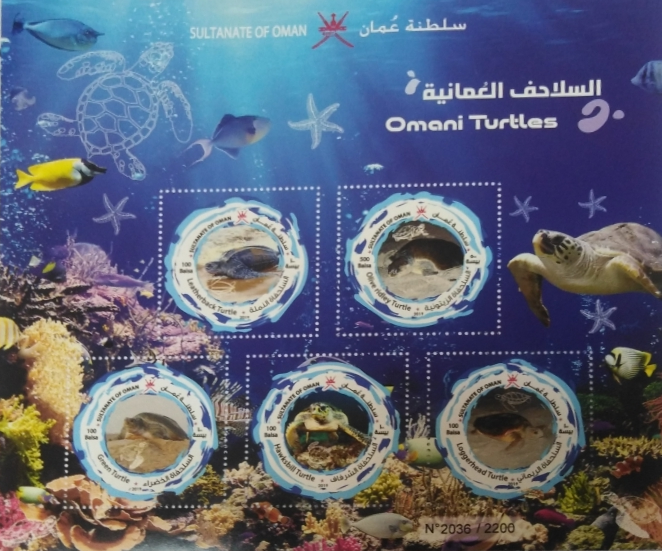
Oman Post Unveils Set of Stamps Highlighting Turtles of Oman

On 29 September 2019, Oman post issued a set of five stamps under the title of Omani Turtles. These stamps have been issued in an effort to promote ecotourism in the Sultanate of Oman by highlighting the marine heritage of Oman. The set of stamps feature five sea turtles which visit Oman every year. They are Hawksbill (Cost: 100 Baisa), Leatherback (Cost: 100 Baisa), Green Turtle (Cost: 100 Baisa), Loggerhead turtle (Cost: 100 Baisa) and Olive Ridley (Cost: 500 Baisa)

 Technical Details

Category: Commemorative

Value: 100 Baisa – 500 Baisa (Omani Rial consists of 1000 Baisa)

Size: 4 cm x 4 cm

Paper: White bright

Printing process: Offset

Printing press: La Poste – France

Number of Stamps: 12000 each

Date of Issue: 29 September 2019


Oman Turtles

According to Mr. Rashad Alwahaibi, Manager (Stamps & Philatelic at Oman Post) “The new colourful stamps depict five turtles found in habitat across Oman. We wanted to showcase that the Sultanate has a huge potential when it comes to marine turtle presence that is yet to be fully leveraged. Having the population of such intriguing species create unique opportunities for the development of a healthy ecotourism sector, but we all need to do our part and support the national agenda when it comes to conservation and collectively work towards the goal of saving these ancient creatures,” (Oman Observer, 29 September, 2019)

Let’s hope that the stamps will increase awareness about the turtles and the need to conserve them. These turtles are Oman’s National Marine Treasure.

Sea Turtles

All over the world there are seven types of sea turtles. Five of them, namely; Green Turtle, Loggerhead Turtle, Hawksbill Turtle, Olive Ridley and Leatherback Turtle visit Oman. The other two, namely: Kemp’s Ridley and Flatback don’t visit either Omani beaches or Omani waters. Every year thousands of sea turtles migrate annually from the shores of the Arabian Gulf, the Red Sea and Somalia to lay their eggs on the various beaches of the Sultanate of Oman.

  • The green turtle lays egg at Ras al Hadd, Ras Al Jinz, Masirah Islands and Daminyat Island.
  • The loggerhead turtle nests at Masirah island, Dhofar and Daminyat Island.
  • The hawksbill turtle nests on the shores of Muscat and Daminyat Island.
  • Oliver Ridley turtle nests on Masirah island.
  • The leatherback visits Oman every year but does not nest in the Sultanate.

Annually these turtles travel long distance to reach the beaches of Oman to nest. The most important nesting place for Green turtles is Ras Al Jinz. Ras Al Jinz is a fishing village located in the Ras Al Hadd area of Sur. Ras Al Jinz is about 40 kms from Sur (Omani city famous for Dhow building). The 45-kilometer-long coastline at Sur is the nesting place for Green Turtles every year. Every year approximately 20000 turtles come to lay around 50000-60000 eggs.

They dig holes on the beaches and lay eggs. After about 2 months (average 55 days), the eggs hatch and the baby turtles come out and rush to the water trying to outrun foxes, crabs and seagulls. If they manage to reach water, they have more chance of survival. Those which survive and grow come back later to the same Omani beaches to lay their eggs. To see baby turtles coming out of the eggs and making a dash to the sea is a sight to behold.

The turtle watching season is June to September. Officially this is the only place where public can watch the various stages of the nesting process under the guidance of experts. It is the Turtle Reserve called Ras Al Jinz Turtle Reserve working since 1996. The reserve has a Turtle Centre working since 2008. The Turtle Centre has helped in reducing commercial harvesting of turtles for meat and shells and provided a safe habitat for the turtles. The Centre conducts two guide tours every day (one in the early morning and another at night) for the public to see the nesting process in an environment which is safe for the turtles. The night tour starts at 9 p.m. while the morning tour starts at 5 a.m. For both the tours one has to be there one hour in advance. It is managed by Oman Tourism Development Company (OMRAN). The fee is 8 Rial Omani for adults, 2 Omani Rial for Children between 5 and 12 years of age while is complimentary for children below that age (it is advisable to check the rates before going there as the rates may change). It is always advisable to book a tour in advance as limited number of tourists are allowed due to conservation issues. There is a museum also at the centre besides a guesthouse providing good accommodation with in house restaurant. There is a very decent souvenir shop also at the centre. For in house guests (those staying at reserve) the rates for the tours are lesser. There is a meeting room as well as a small library.

For more information, please see:

Oman Observer (2019) Oman Post celebrates the Sultanate’s rich biodiversity with launch of five turtle stamps, 29 September. Available at: https://www.omanobserver.om/oman-post-celebrates-the-sultanates-rich-biodiversity-with-launch-of-five-turtle-stamps/. Accessed on 10 October 2019.

http://www.omanpost.om

http://www.rasaljinz-turtlereserve.com

Seminar Report: Idarah Ulum al Qur’an

Idarah Ulum al Qur’an, Aligarh, India (Institute of Qur’anic Sciences, Established 1984) organised a seminar on Qur’anic sciences on 6 October 2019 at its premises. Idarah Ulum Qur’an organises seminar every year on various themes related to the Qur’an, particularly on themes that have relevance to the problems of present day.

This year the annual seminar of the Idarah was somewhat different from previous years. Usually, seminars and conferences have plenty of research papers with hardly any time for the presenter and audience for question and answer. This time around the seminar was confined to only two research papers. For both the papers, two discussants were identified and provided advance copy of the papers so that they get enough time to prepare themselves for discussion. After presentation of the papers, discussants presented their detailed comments. After that the audience was also given enough time to ask questions and offer comments. At the end the presenters were provided opportunity to respond to the comments and questions.

First research paper was presented by Dr. Abu Saad Islahi. It was entitled “The controversies around compilation of the Qur’an: A critical Review”. He mentioned the work done so far, both by traditional and contemporary scholars on the subject. Books of critics (orientalists) and their objections were also taken note of. The researcher also discussed in detail the Muslim response to the criticism by the orientalists.

The second research paper was presented by Dr. Mohiuddin Ghazi. His theme was “Reform Mission of the Qur’an: Narrative and Resources”. His paper emphasized that the Qur’an has placed great importance on the betterment of the individual and the society. The paper highlighted the difference between what the Qur’an enjoins the believers to do and what the believers are actually doing. The paper discussed in detail as to how this objective could be achieved and what methods and resources could be used for it.

On this occasion two books were also released:

  • Methodology for The Translation of the Holy Quran“. Containing the views of late Maulana Amantullah Islahi. It has been compiled by Mohiuddin Ghazi,
  • Relations with Non-Muslims and the Holy Qur’an. This book is a collection of papers from an earlier seminar.

This is a good initiative and hopefully the management of the institute will keep up this tradition in future as well. Rather than quantity, focus should be on quality which can be maintained only if limited number of papers are presented and discussed in detail. This will allow the researchers to further refine and develop their papers before publication. For more details about Idarah Ulum al Qur’an, please visit www.alquran.in

Book Introduction: Animal Farm – Eric Arthur Blair (Pen Name: George Orwell)

This work was strictly voluntary, but any animal who absented himself from it would have his rations reduced by half.”

Animal Farm has fascinated me for a long time. I first read it in high school. Since then I have read it twice more. And how many times I have read passages from here and there, I don’t know. It was written in another time when the world was very different from today. Still it sells like a hot cake because the central theme of the book resonates with the reader.

Animal Farm is an allegorical novella which uses animal characters to describe the power structure of a society. It tells us how power can be manipulated by those in position. The structure of Animal Farm revolved around the events of Russian revolution as they unfolded between 1917 and 1944. The novel was first published in 1945. In my opinion it is one the best as well as one of the most popular fictional political satire to be ever written.

Although the novel allegorically mirrors what was happening in Russian communism and relates specific events with the help of animal characters, the satire takes aim at totalitarianism in all its forms, be it communism, fascism or capitalism. Maybe that is the secret of the books longevity. It tells us that people are basically gullible. They can be easily tricked into believing anything if the information is presented in a palatable way and frequently.

The plot of the novella is very tight with hardly any loose ends. Orwell hits the ground running and holds the control over the plot till the very last. That makes the story a compelling read. The main character of the story is a pig called Major who calls a meeting of all the animals living on a farm called Manor Farm. Major shares a dream which he had previous night about all the animals on the farm living peacefully together. The pièce de résistance was that the farm was managed by animals without any human presence or interference. The Old Major passes away after three days of sharing his dream but three other pigs, namely: Napoleon, Snowball and Squeler use the death of Old Major as a rallying point for animals. The rest of the novella is about how the farm owner, Mr. Jones, is thrown out by the animals and they rename the Manor Farm to Animal Farm and run it themselves. Animals are constantly told how man is bad and how animals are good to rally them around the cause and to keep them committed. Some examples are:

 The only good human being is a dead one”

“Man is the only creature that consumes without producing. He does not give milk, he does not lay eggs, he is too weak to pull the plough, he cannot run fast enough to catch rabbits. Yet he is lord of all the animals. He sets them to work, he gives back to them the bare minimum that will prevent them from starving, and the rest he keeps for himself””

“Man serves the interest of no creature except himself”

“Man is the only real enemy we have. Remove Man from the scene, and the root cause of hunger and overwork is abolished forever. “


After successfully getting rid of Mr. Jones, meetings are called and rules are agreed upon as to how the farm will be run. In the beginning the rules are not only fair but also implemented honestly. However, slowly Napoleon starts taking over the decision making process. Bit by bit the rights giving to the animals are chipped away without them realizing what was happening. By chance if any animal realised what was happening and protested, the argument given in reply is a masterclass in how communism worked:

No one believes more firmly than Comrade Napoleon that all animals are equal. He would be only too happy to let you make your decisions for yourself. But sometimes you might make the wrong decisions, comrades, and then where should we be?”

As the story progresses the slogan “All animals are equal” is changed to “All animals are equal, but some animals are more equal than other

This is a classic example of how fascists come to power by promising the moon to the citizens and how slowly they change the rules of the game to improve their grip over the power structure. In the process the privileges for the ruling class are slowly increased at the cost of the citizens. By the time the people realise what has hit them, it’s too late. The damage is already done.

Whenever anything wrong goes on the farm, some or the other animal is blamed. Napoleon cannot do any wrong. He is always right. Napoleon and other pigs start wearing cloths and living inside the house. The pigs even start walking on their hind legs like humans. One by one the old animals who had seen the farm before the revolution die mostly due to overwork or age. Finally, a day comes when Napoleon invites a neighboring farmer to dinner to discuss possible business alliance. The proposal was to change the name of the farm back to Manor Farm. The most powerful image for me in the whole novel is when Pigs are talking to the farmer at the dinner table. Some animals manage to peer inside the house through the window and are unable to differentiate the two because the pigs have become too much like their former oppressor i.e. human beings.

The creatures from outside looks from pig to man, and from man to pig, and from pig to man again; but already it was impossible to say which was which”


Book Introduction: 1984: A Novel – Eric Arthur Blair (Pen Name: George Orwell)

Author: Mohsin Aziz

My political science teacher during bachelor second year suggested a list of books to read to better understand political thought. Most of the books in the list of recommended books were about political system and political thought of England, USA and India. But there was also a novel in that list. That novel was 1984: A Novel. It caught my attention. I immediately went to the central library and got hold of the only novel in that list. To me reading a novel seemed like far more interesting than reading textbooks on political thought and political philosophy. That was my first introduction to and interaction with 1984: A Novel. That was year 1994.

However, I could not complete it. Probably it was my lack of comprehension that prompted me to give up after reading maybe about 15 pages. The same novel was suddenly in news with its sales skyrocketing after the election of Donald Trump as the President of The United States of America. The Trump team made certain false claims about the number of people attending his oath taking ceremony. When confronted with facts, Trump’s advisor Kellyanne Conway said it was ‘Alternative Fact’. The social media was immediately abuzz and people started connecting the catchphrase ‘Alternative Fact’ with the word ‘Doublethink’ used by George Orwell in his novel 1984. The sales of 1984 suddenly picked up and it was in the top selling books on Amazon in USA. The jump in sale was astronomical 9500%. The only other time when there was such a huge interest in the novel was in 1984. The reason at that time was very simple: it was 1984. I read the news and forgot about it. Sometimes back while travelling to India from Muscat, I saw the novel at Airport. I don’t know why I just went ahead and bought it.

Once I started reading the novel I couldn’t keep it down. I kept reading the book while waiting to board the plane. I kept reading the book during my entire journey. I continued reading the book while in taxi from airport to home. By the time I finished the book I was home.

1984 is a classical dystopian masterpiece by George Orwell. Since its publication in June 1949 by Secker & Warburg, it has been regularly included in the list of best novels and must read books. It’s a cold war period novel that still evokes interest and fear among readers in equal measure. Although it is a cold war novel, unlike other books of its genre (a good example could be Arthur Koestler’s novel “Darkness at Noon” written in 1940 describing life under communism), it does not describe what was happening at that time but rather what modern day liberal democracies can do with the freedom of their citizens in the name of saving democracy. 1984 tells us how liberal democracies can take away the freedom of their citizens disregarding all the rules of law in the name of saving democracy by trampling the very freedom given by the same democracy.

While reading the novel the first feel you get is that yes I know what Orwell is talking about. Words like Doublethink, Ministry of Peace (in the novel it actually wages war against everybody including its own citizens), Ministry of Love (deals in pain and despair. Its job is to annihilate any dissident in the country), Ministry of Truth, Thought Crime, Thought Police, Unperson, Memory Hole, Big Brother etc. And yes it talks about novel writing machines which dish out pornography to buy off the masses by keeping them busy in trivial pursuits. The novel actually tells us how regimes work. It opens our eyes to the modus operandi of regimes.

Regimes work by juxtaposing perception over reality and constantly lying until the lie becomes the truth. This is also done by systematically stripping the meaning out of language. The regimes eradicate ideas and meaning from the words unless they are out of dictionary or their meaning is changed. States real enemy is reality itself. Regimes do everything in their control to make it impossible to understand the real world. Reality is replaced with phantoms and lies. If anyone gets caught saying or believing the truth, he should be ready for torture unless he agrees with the regimes version of reality. The protagonist in the novel finds out that after torture the state could actually “get inside you” and “something was killed in your breast; burnt out, cauterized out” until you agree that two plus two is five.

Another all-time favorite method adopted by regimes to control power is by shifting blame to a designated scapegoat. Every effort is put to make people hate and channelise the anger, hatred and violence towards the designated enemy. Toward achieving this objective is the Ministry of Truth which is responsible for constant updation of history to suit modern circumstances and shifting alliances (doesn’t it sound chillingly familiar with history being rewritten all over the world today). In the novel it is Winston Smith, the protagonist, who works as a censor in the Ministry of Truth. His job is to suitably update history. To make sure he and others do their job properly, they are always watched and controlled by the all-knowing and all-seeing Big Brother.

The most bone chilling and hair raising aspect of this is the Two Minute Hate. It is the daily public period during which all the members of the Outer Party (ruling party) of Oceania (imaginary country) must watch a film. The film depicts the enemies of the state. Party members are required to openly and loudly express hate for the enemy shown in the movie. The purpose of the daily regime of Two Minute Hate was to allow party members to vent their existential anger and hate at the state enemy shown in the movie. Orwell has beautifully described two minute hate. Just read the passage and enjoy and feel worried at the same time.

“The horrible thing about the Two Minute Hate was not that one was obliged to act a part, but that it was impossible to avoid joining in…A hideous ecstasy of fear and vindictiveness, a desire to kill, to torture, to smash faces in with a sledgehammer, seemed to flow through the whole group of people like an electric current”.

This also shows how the state deals with the so called subversive people. “People simply disappeared, always during the night. Your name was removed from the registers, every record of everything you had ever done was wiped out, and your one-time existence was denied and then forgotten. You were abolished, annihilated: vaporized was the usual word

Over the decades since it was written, 1984 has been dismissed many times over as past its sell by date. Yes, things have not gone bad to the extent as discussed in 1984. Did Orwell really get it all wrong. As very beautifully described by Lynskey (2019) By definition, a country in which you are free to read Nineteen Eighty-Four is not the country described in Nineteen Eighty-Four,”. However, the darker tendencies detailed in the novel about the state and the pupil come to the fore again and again in some form or the other. The way regimes try to mould public opinion using media is no secret. Similarly, the use of internet and mobile technology, particularly social media, to spread fake news and ‘Alternate Facts’ is a reality. Yes, there is no Big Boss directly watching us but the technology makes it possible for the powers that be to monitor each and every move that we make. Still it is not entirely correct to blame the state. People are equally guilty of falling prey to the base instincts. We regularly hear news about discrimination against refugees, people of colour or women from different parts of the world. However, there is no denying the fact that reading 1984 decades after it was first published still sends chill up one’s spine and makes the hair stand on the back of the neck. Whatever way we look at it, without doubt, 1984 is one of the best 20th century literary work which will continue to amaze readers for a long time to come.


Interesting Quotes from the novel

  • “The Party told you to reject the evidence of your eyes and ears. It was their final, most essential command”
  • “It was a bright cold day in April, and the clocks were striking thirteen”
  • “Big brother is watching you”
  • “War is peace, Freedom is slavery, Ignorance is strength”
  • “A hideous ecstasy of fear and vindictiveness, a desire to kill, to torture, to smash faces in with a sledgehammer, seemed to flow through the whole group of people like an electric current, turning one even against one’s will into a grimacing, screaming lunatic”
  • “The past was dead, the future was unimaginable.”
  • “Who controls the past”, ran the Party slogan, “controls the future: who controls the present controls the past”
  • “Until they become conscious they will never rebel, and until after they have rebelled they cannot become conscious.”
  • “A nation of warriors and fanatics, marching forward in perfect unity, all thinking the same thoughts and shouting the same slogans, perpetually working, fighting, triumphing, persecuting – three hundred million people all with the same face”
  • “Under the spreading chestnut tree I sold you and you sold me: There lie they, and here lie we under the spreading chestnut tree”
  • “She did not understand that there was no such thing as happiness, that the only victory lay in the far future, long after you were dead, that from the moment of declaring war on the Party it was better to think of yourself as a corpse”
  • “The Lottery, with its weekly pay-out of enormous prizes, was the one public event to which the proles paid serious attention … It was their delight, their folly, their anodyne, their intellectual stimulant … the prizes were largely imaginary. Only small sums were actually paid out, the winners of the big prizes being non-existent persons”
  • “Oranges and lemons, say the bells of St Clement’s, You owe me three farthings, say the bells of St Martin’s”
  • “Freedom is the freedom to say that two plus two make four. If that is granted, all else follows”

References and for more details see:

CNBC (2017)’1984′ Sales soar after Trump claims, ‘alternative facts’, CNBC, Janaury 25, 2017. Available at: https://www.cnbc.com/2017/01/25/1984-sales-soar-after-trump-claims-alternative-facts.html. Accessed on 5 October 2019

Freytas-Tamura, K. de (2017) George Orwell’s ‘1984’ Is Suddenly a Best-Seller. New York Times, January 2017. Available at: https://www.nytimes.com/2017/01/25/books/1984-george-orwell-donald-trump.html. Accessed on 6 October 2019.

Lynskey, D. (2019) The Ministry of Truth: The Biography of George Orwell’s 1984. Doubleday.

The Gaurdian (2009) The masterpiece that killed George Orwell. Available at: https://www.theguardian.com/books/2009/may/10/1984-george-orwell. Accessed on 25 August 2019


Sir Syed Excellence Award 2019

The Sir Syed Excellence Award for 2019 has been announced by the Aligarh Muslim University, India. This year the award has been given to Institutions and not individuals in both national and international categories. The award in the international category has been given to the Oxford Centre for Islamic Studies while in the national category it has been awarded to the Darul Musannefin, Azamgarh.

The award carries cash prize worth Indian Rupees two lakhs in the international category and Indian Rupees one lakh in the national category. The award will be presented to the representatives of the respective institutions on the occasion of Sir Syed Day Celebrations on October 17, 2019 at Aligarh.

The Darul Musannefin popularly known as Shibli Academy or Darul Musannefin Shibli Academy is a research institution based in the Indian city of Azamgarh. The idea of a residential academy where scholars can stay and undertake research was concieved by Allama Shibli Nomani (3 June 1857 – 18 November 1914) and he bequeathed his property at Azamgarh city for the purpose. However, he died before he could convert his dream into reality. It was left to his disciples to  establish it. The students fulfilled the teachers wish and Darul Musannefin Shibli Academy was registered three days after his death on 21 November 1914. The founding President of the committee at the time of establishing the academy was Allama Hamiduddin Farahi. Malulana Syed Sulaiman Nadvi was the founding director and secretary. Maulana Masood Ali Nadvi was the founding Manager with two other members namely: Maulana Abdus Salam Nadvi and Maulana Shibli Mutakallim Nadvi.

The purpose of Darul Musannefin Shibli Academy was to:

  • Nurture and sustain a body of scholarly authors.
  • To provide a congenial environment for scholars to create, compile and translate literary works of high scholastic and historical value.
  • To undertake printing and publication of the literary works of the Academy.

The Darul Musannefin since its establishment has nurtured a body of scholars of repute. It provides a congenial academic environment for scholars to create, compile and translate high quality literary work. So far it has published more than 250 high quality books. Some of the best known books of Darul Musannefin are ‘Seerat -un- Nabi’, ‘Al Farooq’ and ‘Seerat- e- Aisha’.

The Darul Musannefin also publishes a widely reputed Urdu monthly ‘Maarif’. The first issue of Maarif was published in July 1916. The journal has already completed 100 years of uninterrupted publication. Most probably it is, at present, the longest surviving Urdu journal in the world.

Congratulations to Darul Musannefin Shibli Academy for the prestigious award. Let us hope and pray that the institution becomes stronger in the days to come.

References:

ttps://www.amu.ac.in/about3.jsp?did=3237

http://www.shibliacademy.org